
From 1981 to 2010, Stanley Druckenmiller ran Duquesne Capital Management for nearly thirty consecutive years and delivered an average annual return of approximately 30% — without a single losing year.
Not a bad year. Not a flat year. No year with a negative return.
That record has never been matched by any fund manager operating at comparable scale over a comparable period. Not Buffett, not Soros, not Dalio. In thirty years, markets crashed in 1987, the dot-com bubble burst in 2000, and the financial system nearly collapsed in 2008. Druckenmiller navigated all of it in positive territory.
He closed Duquesne Capital in 2010 — not because he had to, but because he felt he could no longer reliably deliver those kinds of returns to outside investors. He returned all the money to clients. Today, he manages his own fortune through the Duquesne Family Office, files quarterly 13F reports with the SEC, and remains one of the most closely watched investors alive.
This article covers everything: his biography, age, net worth, the trade that made him famous, what his portfolio holds right now, his current macro views, and the books he has recommended.
Who is Stan Druckenmiller?
Stanley Freeman Druckenmiller was born on June 14, 1953, in Pittsburgh, Pennsylvania. He is 72 years old as of mid-2026. His father was a chemical engineer, and his parents divorced during his elementary school years. He went to live with his father while his sisters stayed with their mother.
At Bowdoin College, Druckenmiller reportedly ran a hot dog stand for extra cash and graduated magna cum laude. He earned a Bachelor of Arts in English and Economics in 1975, then began a PhD program in economics at the University of Michigan — which he dropped out of to start his career in finance.
His financial career commenced in 1977 as a management trainee at Pittsburgh National Bank, where he quickly rose to head of the bank’s equity research group within a year. In 1981, at 28, he founded Duquesne Capital Management.
By 1985 he was consulting for Dreyfus, and by 1986 was running the Dreyfus Fund while maintaining Duquesne. Then, in 1988, he was hired by George Soros to manage the Quantum Fund.
The trade that broke the Bank of England
In 1992, Druckenmiller — as lead portfolio manager of the Quantum Fund — executed what is still considered one of the most consequential currency trades in history.
The context: the United Kingdom had joined the European Exchange Rate Mechanism (ERM) in 1990, committing to keep the pound within a fixed range against the German mark. By 1992, that commitment was becoming increasingly difficult to maintain. The UK economy was struggling, interest rates were high, and Druckenmiller and Soros believed the pound was overvalued and the government would eventually be forced to devalue or exit.
They built a short position against the British pound worth approximately $10 billion.
The Bank of England tried to defend the currency. On September 16, 1992 — a day that became known as Black Wednesday — the British government raised interest rates twice in a single day, first to 12% and then to 15%, trying to attract capital and prop up the pound. It wasn’t enough. Together, they “broke the Bank of England” in 1992 by shorting the British pound, reportedly making over $1 billion in profits during the event known as Black Wednesday.
The UK withdrew from the ERM that night. Druckenmiller had correctly identified a fundamental mispricing backed by government policy that couldn’t be sustained indefinitely — and had the conviction and the position sizing to profit when the inevitable happened.
Druckenmiller left Soros in 2000 after incurring significant losses in technology stocks — a rare stumble, and one he has spoken about with characteristic candor: he had initially resisted the dot-com mania, then capitulated near the peak, and lost over $3 billion across several months as the bubble burst.
Why he shut down a $12 billion fund at the top of his game
In August 2010, with Duquesne Capital managing over $12 billion in assets, Druckenmiller closed the fund, returning all capital to investors. He was 57 years old.
His explanation was honest and, for the investment industry, unusual: he no longer felt confident he could consistently deliver the kinds of returns that had built his reputation. The markets had changed. The pressure of managing outside capital at that scale had begun to affect his decision-making. Rather than lower the bar or gradually underperform, he chose to stop.
Following the closure of Duquesne Capital, Druckenmiller has continued to manage his personal wealth through the Duquesne Family Office, making large-scale investments across global markets.
He was also reported to have made $260 million in 2008 alone — the year the financial system nearly collapsed — a return that suggested his abilities were still very much intact. The decision to close was about integrity, not capability.
Stan Druckenmiller’s net worth
Stanley Druckenmiller is #477 on Forbes’ 2026 Billionaires list. Various sources estimate his net worth differently. Finance Monthly has placed it at approximately $6.9 billion. Bloomberg, which tracks his wealth in real time, declined to provide a specific figure when contacted in January 2026, noting the difficulty of valuing a private family office portfolio with significant non-public positions.
What is documented: he was reported to have made $260 million in 2008 alone. His 30-year track record at Duquesne, compounding at approximately 30% annually on a fund that grew to $12 billion, produced wealth that Forbes now places comfortably in the billions. He has also been a significant philanthropist: a major donor to his alma mater, he has given more than $40 million to higher education institutions like Bowdoin, Brown and Stanford since 2014.
The Q1 2026 13F: what Druckenmiller actually owns
The Duquesne Family Office files quarterly 13F reports with the SEC. As of the Q1 2026 13F filing, dated May 15, 2026, the reported portfolio holds $3.4 billion in assets distributed across 68 disclosed positions.
Before reading the holdings, the standard caveat applies — and matters here more than with most investors: a 13F discloses only long U.S.-listed equity positions. It does not show short positions, non-U.S. holdings, currency trades, bonds, commodities, or any derivatives that aren’t equity-linked. For a global macro investor like Druckenmiller, whose career was built on currency bets, sovereign bond trades, and cross-asset positioning, the 13F is a genuinely partial picture.
With that said, here is what the Q1 2026 filing shows:
Top holdings by portfolio weight:
| Holding | Ticker | Portfolio weight | Approximate value |
|---|---|---|---|
| Natera | NTRA | 18.1% | ~$613M |
| iShares MSCI Brazil ETF | EWZ | 8.7% | ~$294M |
| Insmed | INSM | 5.6% | ~$189M |
| Taiwan Semiconductor | TSM | 5.0% | — |
| BBB Foods | TBBB | ~4.7% | ~$110M |
The five largest positions account for 42.1% of total portfolio value.
The standout position: Natera (NTRA)
Natera was the top holding of the Duquesne Family Office, accounting for 18.1% of the portfolio’s holdings, with the stake worth slightly under $613 million at the time.
Natera is a genetic testing and diagnostics company, best known for its prenatal testing and cancer diagnostics products — not a name that typically appears on lists of famous macro bets. Natera has quietly returned three times more than Nvidia over the past 12 months.
Druckenmiller beefed up his team’s Natera position by 552,249 shares in the first quarter, a ~22% increase. The company received approval from Japan’s medical regulator for its Signatera molecular residual disease test for colorectal cancer patients during the quarter — a significant catalyst for a company whose growth depends on regulatory expansion.
It’s worth noting: Natera is an unprofitable company. In 2025, it reported a net loss of $208.2 million, up from $190.4 million in 2024. Druckenmiller is clearly betting on future growth over current earnings — consistent with his history of making high-conviction bets on structural trends before they become consensus.
The Brazil bet
In early 2026, reports emerged that the Duquesne Family Office had made a substantial investment in Brazil, a bet that had already generated significant returns. The EWZ position (iShares MSCI Brazil ETF) at 8.7% of the portfolio reflects this. Separately, Duquesne significantly increased its conviction in YPF, the Argentine energy company, boosting that stake by 433% in Q1 to $149.6 million.
The combined Brazil/Argentina exposure represents Druckenmiller’s largest single macro theme outside of biotech — a bet on Latin American emerging markets at a moment when many institutional investors remain underexposed to the region.
Major Q1 2026 portfolio moves
Quarter-over-quarter activity in Q1 2026 reflects substantial portfolio reconstruction. Duquesne Family Office disclosed 31 new positions initiated during the period, alongside 23 full exits.
Notable additions: Broadcom (AVGO), Argentina ETF (ARGT), Alcoa (AA), STMicroelectronics (STM), Sea Ltd. (SE).
Notable full exits: Alphabet (GOOG), DocuSign, XLB (materials ETF), Cogent Biosciences.
Duquesne made a meaningful reduction in domestic exposure, which is down 25% for the quarter — exiting financial ETFs and Alphabet, and cutting Coupang, Teva, Woodward and Wabtec heavily.
The pattern is clear: away from broad U.S. market exposure, toward concentrated bets in biotech, semiconductors, Latin American emerging markets, and select cyclical commodity names.
His current macro views
Druckenmiller has been vocal about his macro outlook in a series of interviews in early 2026.
Bearish on the U.S. dollar. “We’re bearish on the U.S. dollar mainly because sort of the top of the historic range in terms of purchasing power. And foreigners are way, way overloaded in dollars,” he said in a Morgan Stanley interview recorded January 30, 2026.
Cautious on AI valuations — but not bearish on AI itself. His investment in AI began with observations from younger analysts who noticed a shift among top engineering graduates from crypto to AI. He bought Nvidia early — and then sold too early, a decision he has publicly regretted. As of early 2026, his portfolio has rotated away from pure-play AI infrastructure names toward more selective bets, while maintaining Taiwan Semiconductor as his largest semiconductor position. “I think contrarianism is overrated,” he told Morgan Stanley. “The macro backdrop today is ripe with crosscurrents: fiscal stimulus, a Federal Reserve unlikely to tighten, stretched valuations, and structural shifts in currencies and commodities.”
Worried about U.S. fiscal trajectory. His concerns about U.S. debt and entitlement spending have been consistent across interviews for several years. He has described the fiscal math as unsustainable and warned that markets may eventually force a reckoning that politicians have repeatedly deferred.
His protégé is the nominated Fed Chair. Kevin Warsh, who was nominated to serve as Chair of the Federal Reserve in 2026, previously worked for Druckenmiller and has been described as his protégé. This is a significant connection that adds an unusual dimension to how markets will interpret Druckenmiller’s public commentary on monetary policy going forward.
On his own edge: In the Morgan Stanley interview, Druckenmiller was characteristically direct about what separates him from other macro investors. “My edge is not IQ, but the decisiveness to pull the trigger.”
What books does Druckenmiller recommend?
Druckenmiller has recommended relatively few books explicitly in interviews, which makes the ones he has mentioned more significant.
Disclosure: This post has affiliate links. If you buy through them, I make a small cut at no extra cost to you.
The Price of Time — Edward Chancellor: This book was recommended by Stanley Druckenmiller as one of the best books he had read recently. Chancellor writes a history of interest rates — the long-debated morality of lending, and how a simple concept evolved into today’s complex and central role in global finance. Given Druckenmiller’s career-long focus on the bond market and interest rates as the master variable of all markets, the recommendation is unsurprising.
Hedge Fund Market Wizards — Jack Schwager: Listed among the top books recommended by Stanley Druckenmiller. The book features extended interviews with fifteen of the most successful hedge fund traders, exploring what makes them consistently profitable across different environments. Druckenmiller himself appears as a subject in The New Market Wizards, the earlier volume in Schwager’s series — required reading for anyone who wants to understand how he actually thinks about trades.
More Money Than God — Sebastian Mallaby: Also cited among books he has recommended. Mallaby’s history of hedge funds — from A.W. Jones in the 1940s through the generation of managers who came to dominate global markets — provides essential context for the environment in which Druckenmiller built his career.
The Intelligent Investor — Benjamin Graham: One of the foundational texts in value investing, recommended across his career as essential grounding for any serious investor.
For the complete list of books that have shaped how the most successful investors in history think, our article on the best books about investing covers the most frequently recommended titles across multiple generations of fund managers.
What investors can learn from Druckenmiller
Druckenmiller’s thirty-year record is so singular that the temptation is to treat his methods as unreplicable. That’s partly true — his ability to synthesize macro data, individual company research, and market positioning across asset classes simultaneously is extremely rare. But several principles from his career are applicable at any level.
Position sizing is where you actually make money. Druckenmiller has said repeatedly that the difference between being right about a trade and making money on it is position sizing. The Bank of England trade wasn’t just a correct directional bet — it was a $10 billion bet on a correct directional call. Most investors who correctly identified the pound as overvalued in 1992 made a fraction of what Soros and Druckenmiller made because they didn’t size the position to match their conviction.
“Invest, then investigate.” The title of the Morgan Stanley interview series captures his actual process. He doesn’t wait for certainty before entering a position. He enters when his research gives him enough confidence to act, then continues to gather information while the trade develops. Waiting for certainty is usually waiting for a worse price.
The market tells you things the data doesn’t. Druckenmiller has consistently said he pays as much attention to how the market reacts to news as to the news itself. If a stock should logically go down on a bad earnings report and instead goes up, that’s more informative than the earnings report.
Great investors admit mistakes quickly and learn from them. His decision to exit Nvidia “too early” — and his willingness to say publicly that he deeply regrets it — is more revealing than most investors’ success stories. The ability to accurately assess both wins and losses without ego is what makes iterative improvement possible.
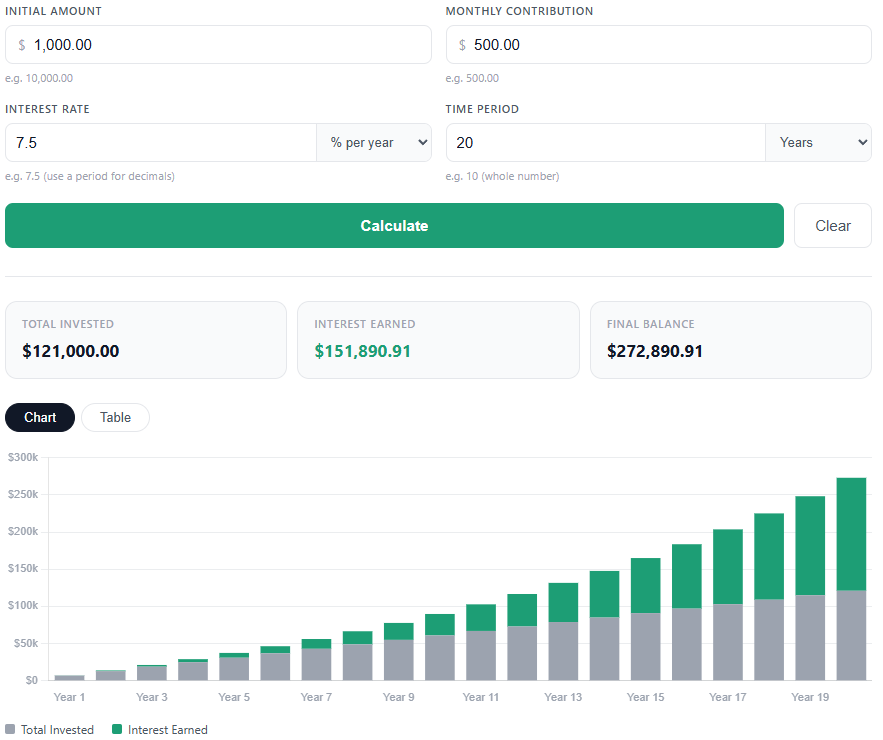
Our Compound Interest Calculator can’t replicate Druckenmiller’s macro genius — but it can model what consistent, positive returns compounded over decades actually look like, which is the mathematical foundation of everything his record represents.
Frequently Asked Questions
What is Stan Druckenmiller’s net worth? Forbes places Druckenmiller at #477 on its 2026 Billionaires list. Various sources estimate his net worth between $4 billion and $6.9 billion. Bloomberg declined to provide a specific figure in January 2026, noting the difficulty of valuing a private family office portfolio. His wealth was built through nearly 30 years managing Duquesne Capital at approximately 30% annual returns and a reported $260 million profit in 2008 alone.
How old is Stan Druckenmiller? Druckenmiller was born on June 14, 1953, in Pittsburgh, Pennsylvania. He is 72 years old as of mid-2026.
What does Druckenmiller’s Q1 2026 13F show? The Duquesne Family Office’s 13F filed May 15, 2026, shows a $3.4 billion equity portfolio across 68 positions. The top five holdings — Natera (NTRA) at 18.1%, iShares MSCI Brazil ETF (EWZ) at 8.7%, Insmed (INSM) at 5.6%, Taiwan Semiconductor (TSM) at 5.0%, and BBB Foods (TBBB) at approximately 4.7% — account for 42.1% of the portfolio. The quarter saw 31 new positions and 23 full exits, with a notable shift away from broad U.S. market exposure toward biotech, semiconductors, and Latin American emerging markets.
Why is Druckenmiller’s largest position Natera, not an AI stock? Natera is a genetic testing and cancer diagnostics company that has returned approximately three times more than Nvidia over the past year despite far less media coverage. Druckenmiller increased his Natera stake by 22% in Q1 2026, bringing it to nearly $613 million (18.1% of the portfolio). While he remains constructive on AI’s long-term potential, his portfolio has rotated away from pure AI infrastructure plays, which he described as “disturbingly heated” in early 2026.
What books does Stan Druckenmiller recommend? Druckenmiller has recommended The Price of Time by Edward Chancellor (a history of interest rates he recently called one of the best books he’d read), Hedge Fund Market Wizards by Jack Schwager, More Money Than God by Sebastian Mallaby, and The Intelligent Investor by Benjamin Graham. He is himself a subject in Schwager’s The New Market Wizards — the most direct window into his thinking in book form.
Did Druckenmiller really go 30 years without a single losing year? Yes — from the founding of Duquesne Capital in 1981 through its closure in August 2010, the fund delivered approximately 30% average annual returns without a single year of negative performance. This includes the 1987 crash, the dot-com collapse, and the 2008 financial crisis. When he closed the fund, he returned all capital to investors because he felt he could no longer reliably deliver those kinds of returns at scale.
What is Druckenmiller’s view on AI in 2026? He is cautious on AI valuations but not bearish on AI as a technological force. He sold Nvidia earlier than he would have liked (“I deeply regret selling Nvidia too early”) and his portfolio as of Q1 2026 has shifted away from pure AI infrastructure plays while maintaining Taiwan Semiconductor as a key semiconductor position. He described AI-linked equities as “disturbingly heated” while seeking value in unloved sectors like biotech and Latin American emerging markets.
Sources and Further Reading
- Wikipedia — Stanley Druckenmiller: https://en.wikipedia.org/wiki/Stanley_Druckenmiller
- Forbes — Stanley Druckenmiller profile (#477 on 2026 Billionaires list): https://www.forbes.com/profile/stanley-druckenmiller/
- Bloomberg Billionaires Index — Stanley Druckenmiller: https://www.bloomberg.com/billionaires/profiles/stanley-f-druckenmiller
- biography.wiki — Stanley Druckenmiller (April 2026): https://biography.wiki/a/Stanley_Druckenmiller
- SEC / 13f.info — Duquesne Family Office LLC 13F filing Q1 2026 (filed 2026-05-15): https://13f.info/manager/0001536411-duquesne-family-office-llc
- InvestorLens — Druckenmiller Q1 2026 13F analysis: https://www.investorlens.capital/investors/stanley-druckenmiller
- U.S. News — Stanley Druckenmiller’s Portfolio: 7 Top Stock Picks in 2026: https://money.usnews.com/investing/articles/stanley-druckenmiller-portfolio-top-holdings
- Seeking Alpha — Tracking Druckenmiller’s Duquesne Family Office Portfolio: Q1 2026 Update: https://seekingalpha.com/article/4923288-tracking-stanley-druckenmillers-duquesne-family-office-portfolio-q1-2026-update
- Motley Fool — Billionaire Druckenmiller’s top holding isn’t Nvidia — it’s Natera (July 2026): https://www.fool.com/investing/2026/07/16/billionaire-stanley-druckenmillers-top-holding-isn/
- RealClearPolitics — Druckenmiller: Portfolio no longer AI-driven, bearish on dollar (March 2026): https://www.realclearpolitics.com/video/2026/03/01/druckenmiller_portfolio_no_longer_ai-driven_bearish_on_dollar_at_historic_purchasing_power_peak.html
- The Acquirer’s Multiple — Druckenmiller: Massive Disruption Ahead (March 2026): https://acquirersmultiple.com/2026/03/stanley-druckenmiller-massive-disruption-ahead/
- Bitget News — Druckenmiller Morgan Stanley “Hard Lessons” interview (February 2026): https://www.bitget.com/news/detail/12560605227664
- Anthony Pompliano / Substack — The Price of Time recommendation by Druckenmiller: https://pomp.substack.com/p/my-top-10-books-from-2023
- Grufity — Duquesne Family Office Q1 2026 portfolio data: https://www.grufity.com/funds/1536411
- Investing Time Daily — Michael Burry’s Portfolio: What Is He Betting Against in 2026?: https://investingtimedaily.com/michael-burry-portfolio-2026/
- Investing Time Daily — Ray Dalio’s Portfolio: Bridgewater, His Family Office, and the All Weather Strategy: https://investingtimedaily.com/ray-dalio-portfolio/
- Investing Time Daily — The Best Books About Investing: https://investingtimedaily.com/best-books-about-investing/
- Investing Time Daily — Compound Interest Calculator: https://investingtimedaily.com/calculators/compound-interest-calculator-free/




Pingback: George Soros: The Trade That Broke the Bank of England