
On Thanksgiving Day, November 28, 1940, just after 5:30 in the afternoon, Jesse Livermore walked into the cloakroom of the Sherry-Netherland Hotel in Manhattan — a place where he often stopped for cocktails — and shot himself with a Colt automatic pistol. Police found a suicide note written across eight small handwritten pages in his personal leather-bound notebook. It was addressed to his wife, Harriet, whom he called Nina.
“My dear Nina: Can’t help it. Things have been bad with me. I am tired of fighting. Can’t carry on any longer. This is the only way out. I am unworthy of your love. I am a failure. I am truly sorry, but this is the only way out for me. Love Laurie.”
He was 63. Eleven years earlier, he had been worth approximately $100 million — one of the richest people in the world — after executing what is still considered one of the most profitable trades in Wall Street history. He had shorted the 1929 market crash while almost everyone else was being wiped out.
His story is not a story of failure. It is a story of a man who understood the market better than anyone alive, and still couldn’t survive it.
From a Massachusetts farm to Wall Street: the making of the Boy Plunger
Jesse Lauriston Livermore was born on July 26, 1877, in Shrewsbury, Massachusetts, to a poverty-stricken family. He learned to read and write at the age of three and a half. At 14, his father pulled him out of school to help with the farm. With his mother’s blessing, Livermore ran away from home.
In 1891, at the age of 14, he found a job as a “board boy” at a Boston branch of the PaineWebber stock brokerage, posting stock quotes on a chalkboard for $5 a week. He spent hours watching the numbers change — the way prices moved, the rhythm of rises and falls. He began to notice patterns nobody had taught him to look for.
In 1892, at 15, he made his first trade at a bucket shop — an establishment that didn’t actually buy or sell stocks, but took bets on whether prices would rise or fall. He bet on five shares of the Chicago, Burlington and Quincy Railroad for $5. He made a profit of three dollars and twelve cents.
He was barely a teenager, and he was already better at this than most adults.
By 16, he had quit his job at PaineWebber and was trading full time at bucket shops across Boston. Fellow traders nicknamed him “The Boy Plunger” — plunger being the period slang for a reckless speculator. He was winning so consistently that Boston’s bucket shops began banning him one by one. He used disguises and false names to keep trading — which only prolonged the inevitable city-wide ban.
By the time he was 20, he had accumulated $10,000 in trading profits — a one thousand percent return over three years. He brought $1,000 home to his mother to repay the $5 she had given him when he ran away. She disapproved of what she called gambling. He corrected her: he was speculating.
The early fortunes — and the early losses
In September 1900, at 23, Livermore moved to New York. He turned $10,000 into $50,000 in five days trading on the long side at Harris, Hutton & Company. Then he anticipated a correction and went short using 400% margin. He lost his entire stake — the ticker tape was too slow to give him the real-time prices he’d been used to at the bucket shops, and his trades were based on data that was already stale.
He borrowed $2,000 from the broker Edward Francis Hutton and moved to St. Louis, where nobody knew him, and went back to the bucket shops to rebuild.
His first genuinely large win came in 1901, at 24: he bought stock in Northern Pacific Railway and turned $10,000 into $500,000.
He was rich. He bought the life that went with it — yachts, apartments, clubs.
In 1906, while on vacation in Palm Beach, he took a massive short position in Union Pacific Railroad the day before the 1906 San Francisco earthquake, based on a tip from businessman Thomas W. Lawson. The earthquake sent the market into a brief panic and the trade made him $250,000. He then went long on the same stock — and was talked out of the position too early by his friend Edward Hutton, losing $40,000 in the process.
The pattern that would define his entire career had already begun: spectacular insight, spectacular execution, followed by a decision that undid the gains.
The Panic of 1907: $1 million in a single day
In the Panic of 1907, Livermore’s short positions made him $1 million in a single day — the equivalent of roughly $35 million in today’s money.
The scale of his profits created a different kind of problem. J.P. Morgan — who had personally bailed out the entire New York Stock Exchange during the same crash, putting up his own money to stop the panic — sent a message to Livermore asking him to stop short selling. The market was in crisis, and Morgan believed Livermore’s continued shorting was making things worse.
Livermore agreed. He reversed course, went long, and profited again from the rebound, bringing his net worth to $3 million. He bought a $200,000 yacht, a private rail car, and an apartment on the Upper West Side.
Then, in 1908, he took advice from cotton trader Theodore “Teddy” Price — who told Livermore to buy cotton while Price was secretly selling. Livermore went bankrupt. He recovered, rebuilt, and went bankrupt again in 1915 — this time, the New York Times marked the occasion with the headline “Cotton ‘King’ A Bankrupt: Jesse L. Livermore Loses Millions He Made in Wall Street.”
After World War I, he cornered the cotton market — quietly accumulated enough of the supply that he could control the price. The move was so significant that President Woodrow Wilson, prompted by the Secretary of Agriculture, called Livermore to the White House for a personal conversation. Livermore agreed to sell back the cotton at break-even. When Wilson asked why he had cornered the market, Livermore reportedly replied: “To see if I could, Mr. President.”
The greatest trade in history: shorting the 1929 crash
By the late 1920s, the United States was in the grip of one of the most extreme speculative manias in its history. The Dow Jones Industrial Average had risen approximately fivefold in six years. Brokers were offering margin loans — investors could buy stocks by putting up as little as one third of the purchase price. The total outstanding amount of margin loans reached $8.5 billion, which was, remarkably, more than the total amount of currency in circulation in the country.
Livermore saw what was coming. In early 1929, he began accumulating short positions — bets that the market would fall. He was so concerned about being identified and having his trades front-run or disrupted that he used more than 100 separate stockbrokers to hide what he was doing.
By spring, the positions were going badly. The market kept rising, and on paper he was down over $6 million. Most traders, facing that kind of loss on a contrarian bet, would have closed the position and moved on.
Livermore held.
On September 3, 1929, the Dow hit its all-time peak of 381.17. Then it started to fall. On October 28 — Black Monday — the market dropped 13%. On October 29 — Black Tuesday — it fell another 12%. In two days, the Dow had lost 25% of its value.
Livermore was on the other side of all of it.
By 1929, Jesse Livermore’s fortunes were at their zenith. He had made a profit of $100 million dollars shorting the markets during the great crash.Upon the Wall Street crash of 1929, he netted approximately $100 million. In today’s terms, that figure is often described as equivalent to $1.5 billion or more.
The reaction was immediate and hostile. Following a series of newspaper articles declaring him the “Great Bear of Wall Street,” he was blamed for the crash by the public and received death threats, leading him to hire an armed bodyguard.
He went home and told his wife, Dorothy, that the family would never have to worry about money again.
He was 52. He was the most famous trader alive.
He had less than five years left with his fortune.
How $100 million disappeared in five years
In just five short years, one of the greatest stock-traders the world has known lost his entire $100 million fortune.
Nobody is fully sure how. Livermore never wrote a clean account of where the money went. Although it is unknown exactly how it happened, he eventually lost his fortune and filed bankruptcy for the third time in 1934, listing assets of $84,000 and debts of $2.5 million.
The most likely explanation, consistent across biographers, is the accumulation of forces that hit him simultaneously — and that all trace back to the same underlying cause.
He kept breaking his own rules.
His second divorce in 1932 was financially devastating. Dorothy received a $10 million settlement. She had custody of their two sons. The house in Great Neck — on which Livermore had spent $3.5 million — was sold for $222,000 and then torn down.
In November 1935, his son Jesse Jr., then 16, was shot by his own mother — Dorothy, now remarried — in a dispute that turned violent. The boy survived, but the incident broke Livermore.
The creation of the U.S. Securities and Exchange Commission in 1934 also imposed new rules that affected how he could trade — the regulatory environment that had allowed him to operate across dozens of brokers simultaneously, hiding his positions from the market, had changed fundamentally.
He was suspended as a member of the Chicago Board of Trade on March 7, 1934.
He paid off an $800,000 tax bill in 1937. In 1939, he opened a financial advisory business, selling a technical analysis system. In March 1940, he published How to Trade in Stocks — his only book under his own name, released eight months before he died. It did not sell well. The country was focused on the war in Europe.
On Thanksgiving Day 1940, he walked into the Sherry-Netherland and wrote the note to Nina.
What the market taught Livermore — and what he couldn’t apply
Livermore’s principles are still studied today, decades after his death. The irony is that he stated them clearly — and spent his entire career violating them.
Cut your losses quickly. Livermore wrote and said repeatedly that the first instinct when a position moves against you is to hold on and hope it comes back. He called this instinct the most dangerous thing in trading, because hope is not a strategy. And yet he held through a $6 million paper loss in early 1929 — in that case, correctly. The lesson he drew was inconsistent: sometimes holding was genius, sometimes it was ruin.
Never trade when you don’t have a clear signal. Livermore believed that the market only offered clear opportunities occasionally, and that trying to trade every day was how most speculators lost money over time. His period at the bucket shops had taught him to wait for patterns. In his later years, under financial and personal pressure, he traded more erratically.
Don’t take tips. His 1908 bankruptcy came directly from following advice from cotton trader Teddy Price — who was secretly on the other side of the trade. Livermore knew better. He had written extensively about the danger of acting on other people’s information. He did it anyway.
The market is designed to fool the most people the most of the time. This was perhaps Livermore’s most durable insight, and it remains the foundation of contrarian thinking in markets today. In 1929, when the consensus was that the boom would continue indefinitely, Livermore went short. He was right. But the same logic that made him rich also made him dangerous to himself — the belief that he alone could see what others missed led him, at other moments, to take positions of extreme concentration at exactly the wrong time.
The contradiction that defined his life was this: he understood the psychology of markets better than almost anyone who has ever traded them. He could not apply that understanding to his own decisions with any consistency.
The book that outlived him
In 1923, journalist Edwin Lefèvre published Reminiscences of a Stock Operator — a semi-fictionalized biography of Livermore, with the main character called “Larry Livingston.” It remains a best-selling book and Livermore’s identity in the book is described as veiled.It was reissued most recently in 2006 with a foreword by financial writer Roger Lowenstein.
The book has sold millions of copies and is on more “required reading” lists for traders and investors than almost any other title. Every principle Livermore articulated is in it. It remains, for many professional traders, the most honest account of what it actually feels like to trade — the euphoria, the terror, the certainty that precedes disaster.
One of Livermore’s own favorite books, according to his biographers, was Extraordinary Popular Delusions and the Madness of Crowds by Charles Mackay — first published in 1841. The same title was also a favorite of his close friend Bernard Baruch. It is a catalog of the manias, bubbles, and collective irrationalities that have defined human financial behavior for centuries. The two men who knew better than anyone how crowds behave in markets both kept returning to the book that explained it.
If you want to go deeper into the books that have shaped how serious investors think, our article on the best books about investing covers the titles most frequently recommended by the investors who came after Livermore.
What Livermore’s story means for investors today
Livermore’s life is not a cautionary tale about markets. Markets worked exactly as they should — they rewarded his insight in 1907 and 1929, and they punished his lack of discipline the rest of the time. The market was not unfair to Jesse Livermore. He was unfair to himself.
The lessons his story leaves behind are not about technical analysis or short selling. They are about something more fundamental.
Knowing the right thing to do is not the same as doing it. Livermore articulated better rules for trading than almost anyone of his era. He broke them repeatedly, under emotional pressure — a divorce, a market moving against him, a tip from someone he trusted. The gap between knowing and doing is where most investment mistakes live.
Leverage amplifies everything — including errors. Every bankruptcy in Livermore’s life came from the same mechanism: a position sized so aggressively that when it went wrong, there was no margin for recovery. His 1929 trade worked because he had been right. Had he been wrong, the same position sizing would have been catastrophic.
The conditions that made a strategy work can change. Livermore’s edge in the early years came from tape reading in an era before regulated exchanges, before standardized financial statements, before the SEC. When that environment changed — when the SEC was created and new rules constrained how he could operate — his methods became less effective. He adapted poorly.
Great trades do not guarantee great outcomes. The 1929 short was the most famous trade of his career and possibly the most profitable single trade in Wall Street history to that point. It did not save him. A single spectacular success cannot substitute for the consistency, discipline, and risk management that compound over a lifetime.
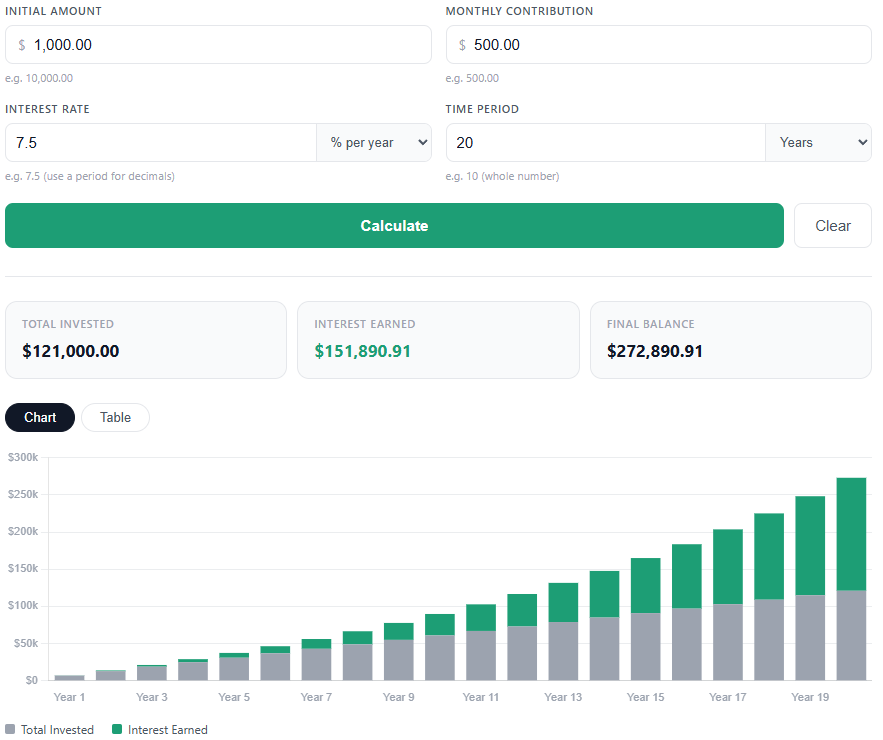
If you want to see how compounding and consistency — the opposite of Livermore’s concentrated bets — build wealth over time, our Compound Interest Calculator lets you model the math that Livermore never quite learned to trust: slow, boring, relentless accumulation.
Frequently Asked Questions
Who was Jesse Livermore? Jesse Lauriston Livermore (1877–1940) was an American stock trader widely regarded as one of the most extraordinary speculators in Wall Street history. He is best known for profiting approximately $100 million by short-selling the 1929 stock market crash, and for repeatedly making and losing multi-million-dollar fortunes across a thirty-year career.
How much did Jesse Livermore make in the 1929 crash? According to his biographers and Wikipedia, Livermore netted approximately $100 million from his short positions during the Wall Street crash of 1929 — equivalent to roughly $1.5 billion or more in today’s money. He had built the positions using more than 100 separate brokers to avoid detection.
How many times did Jesse Livermore go bankrupt? Wikipedia documents three confirmed bankruptcies: the first in 1908 after losing money on bad cotton tips; the second in 1915; and the third in 1934, when he listed assets of $84,000 against debts of $2.5 million, five years after his $100 million peak. Many sources cite four bankruptcies.
How did Jesse Livermore die? Livermore died by suicide on Thanksgiving Day, November 28, 1940, at age 63. He shot himself in the cloakroom of the Sherry-Netherland Hotel in Manhattan. Police found an eight-page handwritten note addressed to his wife Harriet, which read in part: “I am tired of fighting. Can’t carry on any longer. This is the only way out.”
What is Reminiscences of a Stock Operator? It is a 1923 book by journalist Edwin Lefèvre, based on Jesse Livermore’s life and career. The main character is named “Larry Livingston,” but Livermore’s identity is thinly veiled. The book has sold millions of copies and remains one of the most cited texts on trading psychology and market behavior.
What were Jesse Livermore’s main trading rules? Livermore’s principles, articulated in Reminiscences of a Stock Operator and his own book How to Trade in Stocks (1940), included: cutting losses quickly, never averaging down on a losing position, waiting for the market to confirm a move before entering, trading with the trend rather than against it, and never acting on tips. His own career repeatedly illustrated the difficulty of following rules you have written yourself.
What is the most important lesson from Jesse Livermore’s life? That knowing the right thing to do is not the same as doing it. Livermore articulated better investment principles than almost any trader of his era, and then spent forty years breaking them under emotional pressure. The gap between knowledge and discipline is where most investment mistakes — and most investment wealth — are made or lost.
Sources and Further Reading
- Wikipedia — Jesse Livermore (primary source for all biographical facts in this article): https://en.wikipedia.org/wiki/Jesse_Livermore
- New York Times — “Cotton ‘King’ A Bankrupt; Jesse L. Livermore Loses Millions He Made in Wall Street” (February 18, 1915): https://www.nytimes.com/1915/02/18/archives/cotton-king-a-bankrupt-jesse-l-livermore-loses-millions-he-made-in.html
- New York Times — “Jesse Livermore Jr. Shot By Mother in Liquor Row” (November 30, 1935): https://www.nytimes.com/1935/11/30/archives/jesse-livermore-jr-shot-by-mother-in-liquor-row-youth-16-dying-at.html
- New York Times — “Livermore Pays Up His $800,000 Tax Bill” (April 1, 1937): https://www.nytimes.com/1937/04/01/archives/livermore-pays-up-his-800000-tax-bill-speculators-attorney-silent.html
- Forbes — Gregory J. Millman, “The Original Day Trader” (December 27, 1999): https://www.forbes.com/global/1999/1227/073_01.html
- Time Magazine — “Business: Boy Plunger” (December 9, 1940): archived at https://web.archive.org/web/20150709195426/http://content.time.com/time/magazine/article/0,9171,765047-1,00.html
- Edwin Lefèvre — Reminiscences of a Stock Operator (1923, Harriman House reissue 2006): https://amzn.to/4gZtUmb
- Jesse Livermore — How to Trade in Stocks (1940, Duell, Sloan and Pearce): https://amzn.to/3Tq1lEI
- Richard Smitten — Jesse Livermore: The World’s Greatest Stock Trader (2001, Wiley): https://amzn.to/4x7DY1m
- Tom Rubython — Jesse Livermore: Boy Plunger (2015, foreword by Paul Tudor Jones): https://amzn.to/4fy5wFU
- Investing Time Daily — The Best Books About Investing: https://investingtimedaily.com/best-books-about-investing/
- Investing Time Daily — Compound Interest Calculator: https://investingtimedaily.com/calculators/compound-interest-calculator-free/
Disclosure: This post has affiliate links. If you buy through them, I make a small cash reward at no extra cost to you.