
Two numbers define the AI debate in 2026, and they point in opposite directions.
The first: Nvidia reported revenue of $81.6 billion for the quarter ending April 2026 — up 85% year over year. Its data center segment alone generated $75.2 billion, up 92%. These are not projections or promises. They are audited quarterly results from a publicly traded company that makes the chips powering almost every major AI system in existence.
The second: A study commissioned by Goldman Sachs and drawing on MIT research found that 95% of organizations deploying generative AI in 2025 reported getting zero return on their investment. An EY survey found that 99% of companies in its sample reported financial losses due to AI-related risks. And a KPMG survey published in August 2026 found that 78% of business leaders said the primary driver of their AI investment was demonstrating value to investors and boards — not actual measurable results.
Both sets of numbers are real. Both come from credible sources. And the tension between them is the central question in markets right now: is the AI buildout the early stage of a transformative technology cycle that will eventually justify the spending — or is it a speculative bubble, fueled by competitive pressure and narrative momentum, that will eventually correct?
This article does not answer that question. Nobody can answer it with certainty. What it does is lay out the strongest evidence on each side, drawn from verified data and documented expert views, and let readers assess it for themselves.
What is a market bubble?
Before examining the evidence, it’s worth being precise about what a bubble actually is — because the word gets used loosely in ways that make the debate harder to follow.
Economist Hyman Minsky described the classic bubble structure in five stages: displacement (a new technology or opportunity captures attention), boom (prices rise as more participants enter), euphoria (valuations detach from fundamentals), profit-taking (early entrants begin to exit), and panic (the correction arrives as the mismatch between price and value becomes undeniable).
By that framework, the first question to ask about any potential bubble is not “are prices high?” — prices can be high and justified — but “are prices high relative to what the underlying assets will actually produce?” That question, in the case of AI, is genuinely difficult to answer because the relevant time horizon is long and the productivity effects are still emerging.
Historical parallels help frame the stakes but don’t resolve the question. Every transformational technology — railroads in the 1840s, electricity in the 1880s, the internet in the 1990s — went through a period of speculative excess that produced significant financial losses for many investors, even as the underlying technology eventually transformed the economy. The investors who lost money on railroad stocks in 1848 were not wrong about railroads being important. They were wrong about valuations and timing.
The bull case: where the ROI actually shows up
The case for the AI buildout rests not just on projections but on a growing body of documented productivity evidence in specific applications, combined with revenue growth rates at the infrastructure layer that have exceeded even optimistic forecasts.
The infrastructure layer is performing. Nvidia’s fiscal Q1 2027 results, reported in May 2026, showed revenue of $81.6 billion against Wall Street estimates of $78.8 billion — a $3 billion beat. The company guided for $91 billion in the following quarter, authorized an $80 billion share buyback, and raised its dividend twenty-five-fold. Microsoft, whose $80 billion in AI capital expenditure in fiscal 2025 drew significant scrutiny, reported Azure growth of approximately 35% year over year in Q1 2026, with AI services accounting for a growing share of cloud revenue. Google’s Alphabet reported cloud revenue exceeding $20 billion, 800% growth in AI products built on Gemini, and a backlog exceeding $460 billion. These are not speculative projections — they are reported financial results.
Specific applications have produced documented gains. GitHub Copilot, Microsoft’s AI coding assistant, has made AI-assisted code generation standard practice at major technology companies, with some reporting that AI now assists in more than half of all code written. Morgan Stanley deployed an AI tool that handles 98% of financial advisor inquiries with documented productivity gains of three to four times over unaided advisors. Walmart has reported meaningful savings from AI-powered inventory optimization. JPMorgan’s Jamie Dimon disclosed a $1.2 billion AI and modernization budget and projected $1.5 billion to $2 billion in annual AI-generated business value — from the CEO of the largest U.S. bank, who has financial statements audited quarterly.
Goldman Sachs’s own research concluded AI is delivering returns. A Goldman Sachs equity research report published in summer 2026, titled “AI Is Paying Off,” found evidence of productivity gains across the hyperscalers and a subset of enterprise adopters, and argued that the early-stage nature of deployment explains why aggregate productivity statistics haven’t yet shown economy-wide effects. The report noted that Goldman’s own investment banking fees surged 48% year over year, with internal AI tools cited as a contributing factor — though the bank did not specify the dollar attribution.
The Gartner Hype Cycle context cuts both ways. Gartner, the technology research firm, placed generative AI in its “Trough of Disillusionment” in 2026 — a phase in which inflated expectations collide with slower-than-expected real-world results. But Gartner’s own framework describes the trough not as the end of the story but as the normal middle of a cycle that typically leads to a “Slope of Enlightenment” and eventually a “Plateau of Productivity.” Every major technology that became genuinely transformative — including the internet, smartphones, and cloud computing — passed through a trough phase before delivering on its potential.
The bear case: the ROI gap and what critics say
The case for skepticism rests on a documented and widening gap between AI spending and measurable AI results, combined with a pattern in which competitive pressure and narrative momentum — rather than demonstrated returns — appear to be driving investment decisions.
The aggregate productivity evidence is thin. The MIT study cited by Goldman Sachs’s own equity strategist David Covello found that despite $30 billion to $40 billion in enterprise investment in generative AI, 95% of organizations reported zero return on their AI pilots. A 2025 EY survey found that 99% of companies in its sample had experienced financial losses due to AI-related risks, with an average loss of $4.4 million per company. Morgan Stanley’s analysis found only 21% of S&P 500 companies could point to a concrete AI benefit. A Wall Street Journal survey documented a consistent gap between what chief executives report about AI’s impact and what employees on the ground actually describe.
The investment motivation gap is significant. The KPMG survey published in August 2026 found that 78% of business leaders cited demonstrating AI’s value to investors and boards as a critical factor in their AI strategy — not the actual results they were seeing. Goldman Sachs itself titled one of its AI research pieces “FOMO Has Proven a Stronger Incentive Than Poor Stock Performance.” This matters for bubble analysis because it suggests a meaningful portion of AI investment may be driven by perceived necessity rather than documented return — a dynamic that has characterized previous bubble periods.
Gartner’s 2026 data on project failure is stark. Gartner found that 80% of AI projects in 2026 fail to deliver business value. Companies that cut staff to fund AI investments saw identical financial returns to those that did not make staff cuts — suggesting that, in aggregate, the AI spending has not yet produced measurable net productivity gains. Gartner explicitly ties scaling to “improved predictability of ROI,” implying that many organizations are deploying AI before that predictability exists.
The Gartner data on AI project outcomes is more nuanced than headlines suggest. A Gartner survey of 782 infrastructure and operations leaders conducted in November and December 2025 found that only 28% of AI use cases fully succeeded and met ROI expectations, while 20% failed outright. The remaining projects fell somewhere in between — neither fully successful nor abandoned. Among leaders who experienced at least one failure, 57% said their AI initiatives failed because they expected too much, too fast; 38% cited persistent skill gaps; and 38% cited poor data quality or limited data availability as a direct cause. Separately, Gartner predicted in February 2025 that through 2026, organizations would abandon 60% of AI projects that lacked AI-ready data — citing a survey finding that 63% of organizations either did not have or were unsure they had the right data management practices for AI.
The infrastructure concentration creates a specific risk. Michael Burry, whose documented short thesis against Nvidia we cover in detail in our Michael Burry portfolio article, has argued that approximately half of Nvidia’s data center revenue is concentrated among four hyperscalers — Microsoft, Google, Amazon, and Meta. He has estimated that a 20% reduction in Microsoft’s AI capital expenditure alone would reduce Nvidia’s total revenue by more than 4%. Sequoia Capital’s David Cahn has argued that the only scenario in which the projected data center buildout is justified by demand is the arrival of artificial general intelligence — a threshold that remains undefined and undated. “I believe we’re witnessing a race to spend on AI before competitors do, not a race to win on measurable business outcomes,” Cahn wrote in a widely circulated 2025 analysis.
Ray Dalio and Stanley Druckenmiller have expressed caution. Dalio, in his 2026 macro analysis, has described conditions that historically precede bubble corrections, including narrative-driven investment disconnected from underlying cash flows, and elevated valuations in a small number of concentrated names. Druckenmiller has said his portfolio is “no longer AI-driven” and that while he believes AI will eventually be transformative, it will not “pay off on the timetable the market expects.” Both investors’ current views are covered in more detail in our profiles of Ray Dalio and Stan Druckenmiller.
The dot-com comparison: what’s similar and what’s different
The comparison between the current AI buildout and the dot-com bubble of the late 1990s appears in virtually every serious discussion of AI valuations, and it is worth examining precisely rather than dismissing or accepting wholesale.
What is structurally similar:
The infrastructure concentration is comparable. Cisco Systems was, in 1999 and 2000, the indispensable provider of the routers and switches that the internet ran on — just as Nvidia is today the dominant supplier of the GPUs that AI systems run on. Cisco’s revenue was real and growing rapidly. So was its valuation, which reached approximately $550 per share at the peak before falling more than 80%. Michael Burry has explicitly invoked this parallel, writing “it is clearly Cisco” in response to Nvidia’s pushback on his accounting arguments.
The narrative dynamics are similar. Both the dot-com era and the current AI cycle feature a technology that demonstrably works, a genuine long-term case for economic transformation, and a financial market that has attached expectations of near-term returns that the technology may not yet be able to deliver. Both periods feature FOMO — the fear of competitive disadvantage for any company not investing — as a primary driver of capital allocation decisions.
What is structurally different:
The revenue base is real and large in a way that 1999 technology valuations were not. Nvidia’s $81.6 billion quarterly revenue is audited fact, not projection. The companies spending on AI infrastructure — Microsoft, Google, Amazon, Meta — are among the most profitable in corporate history, not pre-revenue startups. The internet in 1999 required the construction of entirely new physical infrastructure that had never existed; AI runs on cloud computing infrastructure that was already built and generating substantial revenue.
The actual productivity gains, while not yet economy-wide, are documented in specific deployments in a way that internet productivity gains were not in 1999. Code generation, customer service automation, and document analysis have produced measurable results in controlled deployments. These existed before the bubble in dot-com stocks burst; they did not exist for most internet business models in 1999.
What Nvidia’s 2026 earnings say — and what they don’t
Nvidia reported its fiscal Q1 2027 results — covering the quarter ending April 2026 — on May 28, 2026. Revenue was $81.6 billion, beating consensus estimates. Data center revenue was $75.2 billion. The company guided for $91 billion in the following quarter.
The stock reaction was instructive: Nvidia fell approximately 1.5% in after-hours trading despite the beat, then declined an additional 4.3% over the following week. Markets appeared to have already priced in results better than those delivered, even though the results were themselves extraordinary by any historical standard.
This phenomenon — a stock falling on objectively strong results — is exactly what bears point to as evidence of bubble-stage valuation. It is also what bulls describe as healthy market functioning: elevated valuations require elevated results, and the market’s job is to price in future expectations rather than react to past performance.
As of the time of writing, Nvidia’s forward-twelve-month price-to-earnings ratio remains significantly above its historical average, and significantly above the S&P 500’s current forward P/E multiple. Whether that premium is justified depends on how quickly AI applications generate sufficient revenue to absorb the current capex cycle — a question that cannot be answered from current data alone.
What we don’t know
The honest answer to “is this a bubble?” is that nobody knows, and anyone claiming certainty in either direction is overstating what the available evidence supports.
What is knowable is the range of outcomes. In one scenario, the productivity gains currently documented in specific applications — code generation, customer service, document processing, drug discovery — diffuse across the broader economy over the next three to five years, AI generates sufficient revenue to justify the current capex cycle, and Nvidia’s current valuation looks cheap in retrospect. In another scenario, the productivity gains remain confined to a smaller set of use cases than the market has priced in, the hyperscaler AI spend begins to rationalize as ROI pressure increases, and the stocks most exposed to that capex cycle reprice substantially. In a third scenario — and historical technology cycles make this genuinely plausible — the technology is transformative but the timing is longer than expected, producing a significant market correction in AI-related stocks before the eventual economic payoff arrives.
Every one of these scenarios has happened before with other transformational technologies. None of them is impossible now.
Putting it in context: what long-term investors do with uncertainty
The question most relevant to individual investors is not which scenario is correct but what, if anything, this analysis should change about how they approach their own financial decisions.
One principle consistent across the investors who have navigated previous technology cycles successfully — from Warren Buffett declining to participate in the dot-com mania because he said he didn’t understand the business models, to Peter Lynch’s emphasis on understanding exactly what you own and why, to John Bogle’s case for index funds over individual stock selection — is that concentrating heavily in any single theme, sector, or narrative, however compelling, carries risks that diversified exposure does not.
This is not investment advice and does not constitute a recommendation to buy or sell any security. Individual investment decisions should be made in consultation with a licensed financial advisor. It is, rather, a description of the documented thinking of experienced investors across multiple market cycles.
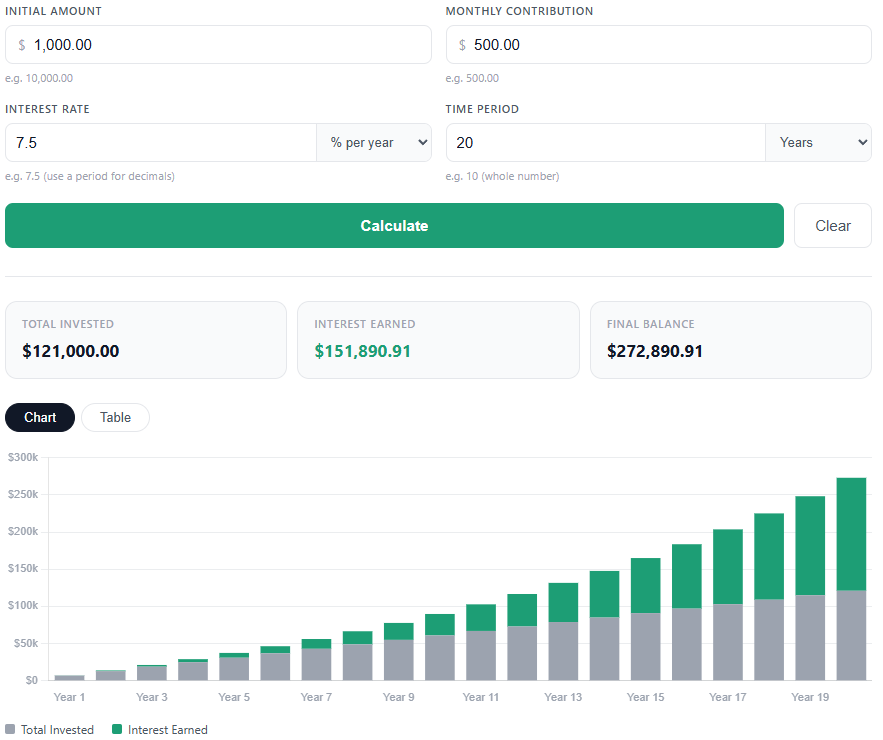
For readers interested in how different return assumptions — optimistic, moderate, or conservative — affect long-term wealth building, our Compound Interest Calculator lets you model those scenarios across 10, 20, and 30-year horizons without any assumptions about which specific sectors or technologies win.
Frequently Asked Questions
Is there an AI bubble in 2026? Whether the current AI investment cycle constitutes a bubble is genuinely debated among serious analysts and investors. The evidence cited by skeptics includes data showing 80-95% of AI projects delivering no measurable return, documented FOMO-driven investment decisions, and structural parallels with the dot-com cycle. The evidence cited by optimists includes Nvidia’s verified quarterly revenue of $81.6 billion, documented productivity gains in specific applications such as code generation and customer service, and the profitability of the companies funding the buildout. This article presents both sets of evidence without reaching a conclusion.
How does the AI bubble compare to the dot-com bubble? The structural similarities include infrastructure concentration in a dominant hardware supplier (Cisco in 1999, Nvidia today), narrative-driven investment ahead of proven economy-wide returns, and FOMO as a primary driver of capital allocation. The structural differences include the revenue base — Nvidia’s quarterly revenue is real and audited, unlike many dot-com companies whose business models were speculative — and the existence of documented productivity gains in specific deployments, which did not meaningfully exist for most internet business models in 1999.
What do major investors think about the AI bubble? Views among major investors are divided. Michael Burry has built a significant short position against Nvidia and Palantir based on his Cisco parallel thesis. Ray Dalio has described bubble-like conditions in the AI sector. Stan Druckenmiller has said his portfolio is “no longer AI-driven.” Jamie Dimon has warned that AI will not “pay off on the timetable the market expects.” On the other side, Goldman Sachs’s equity research has published findings that “AI is paying off” for a subset of enterprise adopters, and the hyperscalers’ financial results have consistently exceeded expectations. Detailed coverage of each of these investors’ current positions is available in our investor profile articles.
What does Gartner’s Trough of Disillusionment mean for AI? Gartner, the technology research firm, placed generative AI in its “Trough of Disillusionment” in 2026 — a phase in its Hype Cycle framework where inflated expectations collide with slower-than-expected real-world results. Gartner’s own framework describes this phase as the normal middle of a technology adoption cycle, not the end of it. Every major technology that eventually became transformative, including the internet, smartphones, and cloud computing, passed through a trough phase. Gartner also noted that 80% of AI projects in 2026 fail to deliver business value and that scaling is “gated by predictable ROI.”
Why is Nvidia’s stock falling even when it beats earnings? Following its fiscal Q1 2027 results — which beat analyst estimates by nearly $3 billion — Nvidia’s stock declined approximately 1.5% in after-hours trading and an additional 4.3% over the following week. This reaction can reflect that the strong results were already embedded in the stock’s valuation, meaning the company needs to exceed not just analyst estimates but also the market’s implicit expectations. Investors who believe the stock already prices in extraordinary future results interpret the reaction as normal; investors who are skeptical of AI valuations cite it as evidence of bubble-stage pricing.
Is this article recommending buying or selling AI-related stocks? No. This article presents verified data and documented expert views from both sides of the AI investment debate without reaching a conclusion or making any investment recommendation. Individual investment decisions should be made in consultation with a qualified and licensed financial advisor. Nothing in this article constitutes investment advice.
Sources and Further Reading
- Nvidia — Fiscal Q1 2027 earnings results (May 28, 2026): https://investor.nvidia.com
- Microsoft — Azure Q1 2026 earnings results and AI revenue disclosures: https://www.microsoft.com/en-us/investor
- Fortune — “FOMO Has Proven a Stronger Incentive Than Poor Stock Performance: Goldman Sachs Finds Insecurity Is a Key Part of the AI Boom” (May 6, 2026): https://fortune.com/2026/05/06/is-ai-a-bubble-goldman-sachs-skeptics-overhyped/
- Fortune — “Goldman: AI Will Save the Economy Someday. First, It Has to Stop Inflating It” (May 4, 2026): https://fortune.com/2026/05/04/is-ai-inflationary-goldman-sachs-gen-z/
- Fortune — “Goldman Sees an AI Bottleneck That Can’t Be Vibe-Coded Away” (May 13, 2026): https://fortune.com/2026/05/13/goldman-sachs-ai-agent-energy-bottleneck-labor-shortage/
- Fortune — “‘At Some Point You’ve Got to Make Money’: Goldman’s Top AI Skeptic Warns the Clock Is Running Out” (June 5, 2026): https://fortune.com/2026/06/05/is-ai-a-bubble-worth-it-short-term-early-goldman-skeptic-covello-profits/
- Fortune — “‘Yet Another Way in Which 2026 Is Looking Like 1999’: Top Analyst Fears Bubble Popping” (June 8, 2026): https://fortune.com/2026/06/08/ai-boom-tech-stocks-bubble-fears-earnings-growth-chipmakers-ipo/
- Fortune — “Wall Street Bulls Are Starting to Admit the Earnings Bubble Is Real — and the 60/40 Portfolio May Be the First Casualty” (August 3, 2026): https://fortune.com/2026/08/03/60-40-investing-strategy-broken-earnings-bubble-big-tech-goldman-apollo/
- Fortune — “Ray Dalio on the AI Bubble Nearing 1929, 2000 Levels” (August 4, 2026): https://fortune.com/2026/08/04/ray-dalio-ai-bubble-1929-2000-ipos-wealth-is-not-money/
- Sequoia Capital — David Cahn, “AI’s $600 Billion Question” (June 20, 2024, updated): https://sequoiacap.com/article/ais-600b-question
- Gartner — Hype Cycle for Artificial Intelligence (updated annually; verify current year edition): https://www.gartner.com/en/newsroom/press-releases
- Investing Time Daily — Michael Burry’s Portfolio: What Is He Betting Against in 2026?: https://investingtimedaily.com/michael-burry-portfolio-2026/
- Investing Time Daily — Ray Dalio’s Portfolio: Bridgewater, His Family Office, and the All Weather Strategy: https://investingtimedaily.com/ray-dalio-portfolio/
- Investing Time Daily — Stan Druckenmiller’s Portfolio: 30 Years Without a Losing Year: https://investingtimedaily.com/stanley-druckenmiller-portfolio/
- Investing Time Daily — George Soros: The $1 Billion Trade That Broke the Bank of England: https://investingtimedaily.com/george-soros-bank-of-england/
- Investing Time Daily — Jesse Livermore: The Man Who Made $100 Million in the 1929 Crash: https://investingtimedaily.com/jesse-livermore/
- Investing Time Daily — Compound Interest Calculator: https://investingtimedaily.com/calculators/compound-interest-calculator-free/