On July 14, 2026, JPMorgan Chase announced the highest quarterly profit in its 226-year history: $21.2 billion in net income for the second quarter, a figure that would be remarkable for a technology company, let alone a bank. Jamie Dimon, the man who has led JPMorgan since 2005, delivered the results and then immediately cautioned investors not to get used to them.
“It’s getting close to as good as it gets,” Dimon told Wall Street analysts on the earnings call. “We just don’t know how long it’s going to last.”
It was his second warning of the day. Earlier that morning, in his written remarks tied to the results, he described risk as “shifting below the surface like tectonic plates” — citing geopolitical wars, sticky inflation, and global fiscal deficits. Less than a month earlier, he had flown to Paris and told Bloomberg there was “a little bit too much exuberance out there” in financial markets. Earlier in the year, in an NPR interview, he described the scenario he most feared as “the skunk at the garden party” — inflation slowly rising instead of falling.
For over two decades, Dimon has led the largest bank in the United States. His track record through crises is unmatched among his peers. And in 2026, with JPMorgan posting record profits and the stock market near all-time highs, he is more cautious about the future than at almost any point in his career.
This article covers who Dimon is, where he came from, what JPMorgan looks like today, what his net worth is estimated to be — with an important caveat about what’s actually verifiable — and exactly what he’s warning about right now.
Who is Jamie Dimon?
James Dimon — known universally as Jamie — was born on March 13, 1956, in New York City. He is 70 years old in 2026. Both his father, Theodore Dimon, and his grandfather worked in finance; his father was a stockbroker at Shearson/American Express. Finance was, in a sense, the family business.
He attended Tufts University, where he studied psychology and economics, graduating in 1978. He worked briefly as a management consultant, then enrolled at Harvard Business School, earning his MBA in 1982. His thesis at Harvard Business School was on the U.S. banking industry — a subject he has since spent four decades studying from the inside.
After Harvard, he joined Sandy Weill, a financier who would become the most important mentor of Dimon’s career. Dimon turned down an offer from Goldman Sachs to work alongside Weill at American Express, where Weill was then president. The choice defined the next sixteen years of his professional life.
The Sandy Weill years: mentorship, acquisitions, and a famous firing
From 1982 to 1998, Dimon worked alongside Sandy Weill through a succession of increasingly ambitious acquisitions that eventually created Citigroup, at that time the largest financial services company in the world.
The partnership was productive and, by most accounts, intense. Dimon was not a subordinate who deferred quietly — he pushed back, raised questions, and built a reputation for demanding accountability from everyone around him, including Weill. For sixteen years, the combination worked.
In November 1998, Weill fired Dimon. The exact reasons have never been fully confirmed by either party — the most commonly reported account is that tensions had accumulated over time, compounded by a conflict involving Weill’s daughter, who had worked at the firm. Neither man has publicly confirmed the specific trigger.
What Dimon has said is that being fired was one of the most important things that happened to him. He spent roughly eighteen months thinking, reading, and meeting with executives before accepting the position of CEO of Bank One, a Cincinnati-based bank that had been struggling.
At Bank One, Dimon did what he would later do at JPMorgan: cut costs, rebuilt culture, demanded performance data in real time, and turned a struggling institution around. In 2004, JPMorgan Chase acquired Bank One. Dimon became president and chief operating officer. In December 2005, he became CEO.
2008: The Last Man Standing
The 2008 financial crisis is the event that defined Dimon’s legacy most completely. While his peers were accepting government bailouts, Lehman Brothers was collapsing, and Bear Stearns was imploding, Dimon was making moves that would define JPMorgan for a generation.
In March 2008, with Bear Stearns facing imminent failure and the Federal Reserve desperate to prevent a disorderly collapse, Dimon agreed to acquire Bear Stearns for $2 per share — with Federal Reserve backing for $30 billion of Bear Stearns’s most problematic assets. The deal was later revised to $10 per share under shareholder pressure. It was a calculated bet, and it paid off: JPMorgan absorbed Bear Stearns’s prime brokerage and investment banking operations, which added significantly to the firm’s competitive position.
Six months later, in September 2008, as Washington Mutual — the largest savings and loan in American history — was seized by regulators, Dimon agreed to acquire its banking operations from the FDIC for $1.9 billion. JPMorgan assumed $307 billion in assets and avoided what would have been the largest bank failure in U.S. history up to that point.
Through all of it, JPMorgan did not take a government bailout through the Troubled Asset Relief Program in the way several of its major competitors did. It accepted $25 billion in TARP funds under government pressure in October 2008, but Dimon has said repeatedly that JPMorgan did not need the money and repaid it as quickly as possible.
The 2008 crisis produced a nickname for Dimon that has followed him since: The Last Man Standing.
The years since have not been entirely smooth. In 2012, JPMorgan disclosed a trading loss of approximately $6.2 billion from a derivatives position managed by a trader nicknamed “the London Whale” — a loss that resulted in significant regulatory penalties and a public reckoning about risk management even at the best-run major banks. Dimon acknowledged the failure directly.
JPMorgan Chase today: the numbers
JPMorgan Chase is, by multiple measures, the largest bank in the United States and one of the largest financial institutions in the world.
As of March 2026, the bank holds approximately $4.9 trillion in assets, operates in 66 countries, and employs more than 318,000 people worldwide. Its market capitalization approaches $1 trillion — a figure that puts it in the company of the largest corporations on earth, in any industry.
The Q2 2026 results that Dimon simultaneously celebrated and cautioned about included net income of $21.2 billion — the highest quarterly profit in JPMorgan’s history. Part of that figure included a $4.6 billion gain on the bank’s Visa stake, which boosted the headline number. Excluding that one-time item, the underlying results were still exceptional.
For the full year 2026, JPMorgan has guided for net interest income of approximately $94.5 billion. The bank’s excess capital sits at $57 billion — a buffer Dimon and his CFO have described as sufficient to absorb a moderate recession with significant reserve builds to spare.
Dimon has been CEO for 21 years. No major U.S. bank CEO has held that position longer in the modern era.
Jamie Dimon’s net worth: what’s actually known
This is where transparency is important, because the numbers cited across financial media for Dimon’s net worth are estimates — not figures he has officially confirmed.
Forbes estimates Dimon’s net worth at approximately $2.3 billion to $2.6 billion as of 2026. Bloomberg’s Billionaires Index places similar figures, though its real-time tracking of a private executive’s wealth involves considerable estimation.
The most verifiable component of his wealth is his JPMorgan Chase stock ownership, which is disclosed in SEC proxy filings because he is an executive officer of a public company. Based on the most recent available filings, Dimon owns approximately 8.6 million shares of JPMorgan Chase common stock. At JPMorgan’s approximate price range in mid-2026, that stake alone would be valued at roughly $2.2 billion to $2.5 billion — which is broadly consistent with the Forbes estimate and suggests that most of Dimon’s wealth is in JPMorgan stock rather than diversified across other assets.
His total annual compensation has been in the range of $35 million to $39 million in recent years, consisting of base salary, cash bonus, and performance-based stock awards.
What is not publicly known: his personal investment portfolio beyond the JPMorgan shares. Dimon does not disclose his personal investments. Given his June 2026 statement that he would not be a buyer of either equities or long-dated U.S. Treasuries at current prices, it is reasonable to assume he holds some proportion of his personal assets in cash or short-duration instruments — but this is inference, not confirmed disclosure.
What Dimon is warning about in 2026
Dimon’s annual letter to shareholders, published on April 6, 2026 — timed to coincide with the United States’ 250th anniversary — is the most detailed annual accounting he provides of his views on the economy, markets, and geopolitics. The 2026 letter is among his most cautionary.
Eight risks “building like tectonic plates”
Dimon described eight major risks that he believes markets are not fully pricing: geopolitical instability from the wars in Ukraine and Iran, trade tensions including tariffs he described as “still pretty extreme,” strained relationships with China, cyber threats he identified as the single biggest AI-related risk in a July 2026 Axios interview, elevated global deficits and debt, a leveraged private credit market, very high asset valuations across multiple sectors, and the fragility of post-WWII global alliances.
His framing of these risks as “tectonic plates” — always moving, periodically causing earthquakes — reflects his view that the danger is not necessarily immediate but structural. He has repeated the metaphor across multiple interviews and earnings calls.
Asset prices are “very high” — and he would not buy them
In a widely reported July 2026 interview on The Master Investor Podcast, Dimon said directly that he would not be a buyer of either equities or long-dated U.S. Treasuries at current prices. He pointed to the stock market being in the top 15% of historical valuations and credit spreads being very low — “the general assumption is that these things are all going to resolve,” he said, implying he does not share that assumption.
The statement carried particular weight given the context: JPMorgan had just posted record quarterly profits. Dimon was not warning from weakness — he was warning from a position of institutional strength, while flagging that the conditions producing that strength were not guaranteed to persist.
Stagflation as the “skunk at the garden party”
Dimon has repeatedly flagged stagflation — a combination of rising inflation and slowing economic growth — as a risk that markets are underweighting. In his annual letter, he described this as “the skunk at the garden party — and it could happen in 2026 — would be inflation slowly going up, as opposed to slowly going down.” He has pointed to geopolitical disruptions, particularly oil-related shocks from the Iran conflict and the continuing Russia-Ukraine war, as potential triggers.
The dollar and military power
On August 11, 2026, in one of his most striking recent statements, Dimon issued a warning about the long-term status of the U.S. dollar as the world’s reserve currency. Speaking on PBS’s “Firing Line,” he linked the dollar’s dominance explicitly to American military and economic supremacy: “If America is in a weakened state — like if we’re not the strongest military in 25 years and the strongest economy — we won’t be the reserve currency either.”
He estimated that de-dollarization could unfold over the next 25 years if U.S. leadership in both dimensions erodes. His view is not that the dollar is in imminent danger, but that the structural underpinning of its reserve status — military capability and economic scale — is not automatic and cannot be taken for granted.
On artificial intelligence
Dimon’s view on AI is nuanced in a way that is frequently simplified in coverage. He is a significant investor in AI: JPMorgan’s technology and branch expansion budget runs to $105 billion, and the bank employs thousands of engineers and data scientists. He believes AI will eventually pay off for the economy. But in the same July 2026 Axios interview where he identified cyber threats as AI’s biggest risk, he said: “Will it in total pay off? Probably, just like the internet did. Will it pay off the way you expect and the timetable you expect? Definitely not.”
This is a meaningfully different view from the broad enthusiasm that has driven AI-linked equity prices. It is also the view of the CEO of the institution with perhaps the broadest visibility into corporate AI spending across the American economy.
Succession: JPMorgan without Dimon
Dimon, who turned 70 in 2026, has not set a timeline for his departure. At JPMorgan’s annual investor day in May 2026, he said “nothing’s changed” from the prior year regarding succession. The board is responsible for the decision.
The most frequently named internal candidate is Marianne Lake, who runs JPMorgan’s consumer and community banking division. Lake spoke at the May 2026 investor day and addressed the bank’s economic outlook in terms that broadly aligned with Dimon’s more cautious framing.
Dimon’s longevity as CEO — 21 years and counting — has created a situation somewhat analogous to Warren Buffett’s succession at Berkshire Hathaway: an institution so associated with one individual that the transition, when it comes, will inevitably be discussed as a structural event for the bank rather than a routine leadership change. The full Greg Abel analogy holds — succession questions loom over both companies, and both men have declined to give definitive timelines.
What this means for individual investors
Dimon’s warnings are not investment recommendations, and this article does not treat them as such. He is not advising you to buy or sell anything. He is describing, from a position of unprecedented visibility into the global financial system, the risks he believes are underpriced.
Several of the structural concerns he raises — elevated asset valuations, geopolitical fragility, the long-term trajectory of U.S. fiscal deficits — are themes that serious investors across the spectrum, from Ray Dalio to Stan Druckenmiller, have also been raising throughout 2025 and 2026. The convergence of cautionary views among the most experienced large-scale investors alive is worth noting, even if the timing of any market correction remains, as always, impossible to predict.
What Dimon does consistently is distinguish between concerns that are structural and long-term — the tectonic plate risks — and his view of the underlying resilience of the U.S. economy in the near term. The bank he leads just had its best quarter in history. He is not predicting imminent collapse. He is saying the margin of safety is thinner than markets appear to believe.
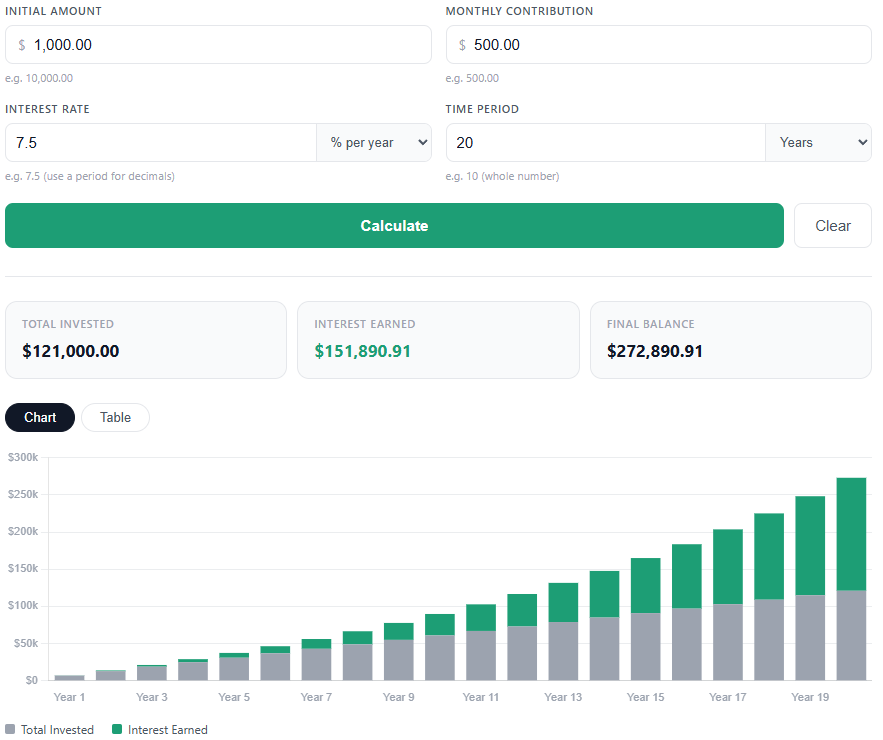
If you want to understand how different return environments affect long-term wealth building — whether markets deliver the last decade’s results or something more moderate — our Compound Interest Calculator lets you model those scenarios across 10, 20, and 30-year horizons.
For context on how Dimon’s view fits into the broader landscape of experienced investors who are cautious right now, our profiles of Ray Dalio, Stan Druckenmiller, and Michael Burry cover three other prominent investors who have expressed structurally similar concerns from different vantage points in 2026.
Frequently Asked Questions
Who is Jamie Dimon? James “Jamie” Dimon (born March 13, 1956, in New York City) is the chairman and CEO of JPMorgan Chase, the largest bank in the United States. He has led JPMorgan since 2005, steering it through the 2008 financial crisis without a government bailout, completing the acquisitions of Bear Stearns and Washington Mutual, and growing the bank to approximately $4.9 trillion in assets. He is 70 years old as of 2026.
How much is Jamie Dimon worth? Forbes estimates Dimon’s net worth at approximately $2.3 billion to $2.6 billion. This is an estimate, not an officially disclosed figure. The most verifiable component is his JPMorgan Chase stock ownership — approximately 8.6 million shares, disclosed in SEC proxy filings — which at mid-2026 prices would be worth approximately $2.2 billion to $2.5 billion. His total annual compensation has been in the range of $35 million to $39 million in recent years.
What is Jamie Dimon warning about in 2026? In his April 2026 annual letter, interviews through the year, and a statement on August 11, Dimon has flagged eight major risks including geopolitical instability from the wars in Ukraine and Iran, persistent inflation, very high asset valuations, a leveraged private credit market, the fragility of global alliances, and elevated deficits. He specifically warned that the U.S. dollar’s status as the world’s reserve currency depends on maintaining military and economic supremacy, and that de-dollarization could unfold over 25 years if that strength erodes.
What did Jamie Dimon say about stocks in 2026? In a July 2026 interview, Dimon said he would not be a buyer of either equities or long-dated U.S. Treasuries at current prices, pointing to the stock market being in the top 15% of historical valuations and credit spreads being very low. He warned of “a little bit too much exuberance” in markets in a May 2026 Bloomberg interview. He has repeatedly stated that markets are not fully pricing the risks he sees.
What is JPMorgan Chase’s net income in 2026? JPMorgan Chase reported net income of $21.2 billion for Q2 2026, the highest quarterly profit in the bank’s history. Part of that figure included a $4.6 billion one-time gain on its Visa stake. The bank has guided for full-year 2026 net interest income of approximately $94.5 billion.
Who will succeed Jamie Dimon as JPMorgan CEO? Dimon has not announced a timeline for his departure. At the May 2026 investor day, he said “nothing’s changed” regarding succession and that the decision is up to the board. The most frequently named internal candidate is Marianne Lake, head of JPMorgan’s consumer and community banking division.
How is Jamie Dimon different from Warren Buffett as an investor? Dimon runs an operating company — the largest U.S. bank — and does not publicly manage a disclosed investment portfolio the way Buffett did at Berkshire Hathaway. His public comments on markets reflect his view from inside the financial system rather than a specific set of holdings. Buffett was primarily a capital allocator who held concentrated long-term positions; Dimon is a banker who offers macro economic views publicly while managing the largest financial institution in the country. His successor question parallels the Greg Abel transition at Berkshire — both institutions are working through leadership succession after decades defined by a single dominant CEO.
Sources and Further Reading
- Wikipedia — Jamie Dimon biography: https://en.wikipedia.org/wiki/Jamie_Dimon
- CNBC — Jamie Dimon annual letter to shareholders, April 6, 2026: https://www.cnbc.com/2026/04/06/jpmorgan-ceo-jamie-dimon-annual-letter-risks.html
- Fortune — JPMorgan Q2 2026 record profits: “Getting close to as good as it gets” (July 14, 2026): https://fortune.com/2026/07/14/jamie-dimon-warning-jpmorgan-goldman-earnings/
- Fortune — Jamie Dimon warns dollar dominance depends on US military power (August 11, 2026): https://fortune.com/2026/08/11/jamie-dimon-dollar-dominance-military/
- CNBC — JPMorgan Chase CEO Jamie Dimon says markets underestimate risks (July 21, 2026): https://www.cnbc.com/2026/07/21/jpmorgan-chase-ceo-jamie-dimon-market-risk.html
- TheStreet — JPMorgan doubles down on stock market message for 2026 (May 14, 2026): https://www.thestreet.com/investing/stocks/jpmorgan-doubles-down-on-stock-market-message-for-2026
- Fortune — Dimon’s biggest risk shifts from geopolitics to cyber (April 30, 2026): https://fortune.com/2026/04/30/jamie-dimon-geopolitics-cyber-economic-risks-threats/
- Moneywise — Jamie Dimon warns 8 risks building “like tectonic plates” (April 9, 2026): https://moneywise.com/news/economy/jamie-dimon-risks-us-economy-tectonic-plates-stagflation
- Motley Fool — In 12 words, Jamie Dimon just issued a stark warning (July 30, 2026): https://www.fool.com/investing/2026/07/30/in-12-words-jpmorgan-ceo-jamie-dimon-just-issued-a/
- GuruFocus — JPMorgan Jamie Dimon warns on dollar’s future amid military power concerns (August 11, 2026): https://www.gurufocus.com/news/9026342/jpm-jamie-dimon-warns-on-dollars-future-amid-military-power-concerns
- JPMorgan Chase — Annual Report and Proxy Filing 2026 (shareholding disclosure): https://www.jpmorganchase.com/ir
- Investing Time Daily — Ray Dalio’s Portfolio: Bridgewater, His Family Office, and the All Weather Strategy: https://investingtimedaily.com/ray-dalio-portfolio/
- Investing Time Daily — Stan Druckenmiller’s Portfolio: 30 Years Without a Losing Year: https://investingtimedaily.com/stanley-druckenmiller-portfolio/
- Investing Time Daily — Michael Burry’s Portfolio: What Is He Betting Against in 2026?: https://investingtimedaily.com/michael-burry-portfolio-2026/
- Investing Time Daily — Greg Abel: Who Is Warren Buffett’s Successor at Berkshire Hathaway?: https://investingtimedaily.com/greg-abel-berkshire-hathaway/
- Investing Time Daily — Compound Interest Calculator: https://investingtimedaily.com/calculators/compound-interest-calculator-free/