At 7:00 on the evening of September 16, 1992, the British government made an announcement that had never been made before and has never been made since: the United Kingdom was withdrawing from the European Exchange Rate Mechanism, the currency system that Britain had joined just two years earlier as a cornerstone of its European economic policy.
In a matter of hours that day, the Bank of England had raised interest rates twice — first from 10% to 12%, then to 15%, the highest rate in years — in a desperate attempt to defend the British pound against an onslaught of selling pressure it couldn’t withstand. It had spent approximately £3.4 billion of taxpayer money buying its own currency in the open market. It had failed.
On the other side of that trade sat George Soros and his Quantum Fund, which had built a short position in the pound worth approximately $10 billion. When Britain capitulated and the pound fell 15% against the German Deutsche Mark, the Quantum Fund made approximately $1 billion in profit — in a single day.
Soros didn’t invent the trade. He didn’t see something no one else had seen. He bet bigger than anyone else on something many people already suspected — and he was right. That distinction is at the heart of what made him the most famous currency trader in history, and why his story still matters thirty years later.
From Budapest to the London School of Economics
George Soros was born György Schwartz on August 12, 1930, in Budapest, Hungary. He is 95 years old in 2026. His father, Tivadar, was a Jewish lawyer who had survived a prior ordeal — captured during World War I, he had escaped from a Soviet prisoner-of-war camp in Siberia and made his way back to Hungary across thousands of miles of difficult terrain. That experience shaped Tivadar’s approach to adversity: when threatened, he moved, adapted, and found creative ways to survive. He passed that instinct to his son.
In 1936, as anti-Semitic persecution was intensifying across Europe, Tivadar changed the family’s surname from Schwartz to Soros — a Hungarian word that means “will soar” in Hungarian and “next in line” in Esperanto, a language the father spoke and had taught his children.
When the Nazis occupied Hungary in the spring of 1944, more than 500,000 Hungarian Jews were deported to concentration camps. The Soros family survived by securing false identity papers. George, then 13, posed as the godson of a Hungarian official. Later in life, Soros would describe 1944 as his formative year — the experience of resisting an overwhelming evil and surviving it.
After the war, as Hungary came under Communist control, Soros left in 1947 for London. He was 17. To support his studies at the London School of Economics, he worked part-time as a railway porter and as a nightclub waiter. At the LSE, he studied under the philosopher Karl Popper, whose book The Open Society and Its Enemies — a critique of totalitarian systems and a defense of liberal democracy — became the intellectual foundation of everything Soros would later do with his money.
He graduated with a bachelor’s degree in 1952, worked briefly at London merchant bank Singer & Friedlander, and emigrated to the United States in 1956. Over the following seventeen years, he moved through a series of Wall Street positions — F.M. Mayer as an arbitrage trader, Wertheim & Company as an analyst, Arnhold and S. Bleichroeder as a vice president — before founding his own firm in 1973.
The Quantum Fund: 31% annual returns for three decades
In 1970, Soros co-founded the Quantum Fund with investor Jim Rogers. What followed was, by any objective measure, one of the most successful investment records in the history of money management. The Quantum Fund returned approximately 31% annually over its first thirty years of operation.
To understand what that means in concrete terms: $1,000 invested in the Quantum Fund at its founding in 1970 would have grown to approximately $4 million by 2000. The S&P 500, over the same period, would have grown that $1,000 to approximately $75,000 — extraordinary in its own right, but a fraction of what Soros achieved.
Soros’s investment framework was built around a concept he called reflexivity — his single most original intellectual contribution to finance, and the idea that undergirded the Bank of England trade.
Traditional economic theory assumes that market prices reflect rational assessments of underlying value — that buyers and sellers process available information efficiently and that prices therefore tend toward equilibrium. Soros rejected this. He argued that market participants’ perceptions are inherently biased and incomplete, that those biased perceptions influence market prices, that those price changes then influence the underlying fundamentals that participants are trying to assess, and that this creates feedback loops — trends that reinforce themselves, sometimes to absurd extremes, before eventually reversing.
Applied to currencies: if markets believe a currency is overvalued, they will sell it. That selling weakens the currency. The weakening currency makes the country’s economic position worse. Which makes the currency weaker still. The self-fulfilling prophecy is not a bug in the system — it is, in Soros’s framework, how the system actually works.
In 1988, Soros hired a young fund manager named Stanley Druckenmiller to manage the Quantum Fund’s day-to-day portfolio — the same Druckenmiller who would later build his own remarkable record at Duquesne Capital. This partnership between Soros and Druckenmiller would produce the most famous trade in the history of global currency markets.
The target: Britain and the European Exchange Rate Mechanism
To understand the Bank of England trade, you need to understand the European Exchange Rate Mechanism — the system that made it possible.
The ERM was created in 1979 as a precursor to European monetary union. Member countries agreed to keep their currencies within narrow bands against each other, using the German Deutsche Mark as the central anchor. Germany’s Bundesbank — famous for its iron commitment to low inflation — set the reference interest rate that other member countries were effectively required to shadow.
Britain had stayed out of the ERM for its first eleven years of existence. On October 8, 1990, the Chancellor of the Exchequer John Major persuaded a skeptical Prime Minister Margaret Thatcher to join at a central rate of 2.95 Deutsche Marks per pound, with a permitted fluctuation band of plus or minus 6%.
The decision was politically significant and economically risky. Britain’s economy was already in recession. Unemployment was rising. The country needed lower interest rates to stimulate growth — but membership in the ERM meant its interest rates had to track Germany’s, which were high because Germany was managing the inflationary effects of reunification. Britain was trapped: it needed cheap money but was locked into expensive money by treaty.
Throughout 1991 and into 1992, the fundamental case for a pound devaluation became increasingly obvious to professional currency traders. The question was not whether Britain could maintain the ERM peg indefinitely — the economics said it couldn’t. The question was when the reckoning would come, and whether the British government had the political will to accelerate its own exit or whether it would wait to be forced out.
Building the position: Soros bets $10 billion
Druckenmiller identified the opportunity first. Through late 1991 and the first half of 1992, the Quantum Fund began building a short position in the British pound — borrowing pounds and selling them in exchange for other currencies, with the expectation of buying them back later at a lower price once the devaluation came.
By late summer 1992, the position had grown to approximately $7 billion. Druckenmiller brought the situation to Soros. His analysis was that the trade was likely to work — that the pound was fundamentally overvalued at its ERM rate and that Britain would eventually be forced to either devalue or exit.
Soros’s response became one of the most quoted instructions in the history of trading. According to Druckenmiller’s own account, Soros told him the position was too small. The opportunity was clear, the downside was limited by the ERM band itself, and the upside was enormous. Soros told him to go for the jugular. The position was doubled to $10 billion.
Other hedge fund managers were watching the same situation. Paul Tudor Jones and Bruce Kovner also took large short positions against the pound. This collective pressure on the pound accelerated in September as the currency came under increasing market stress.
On September 15, 1992, the selling intensified. On the morning of September 16, markets opened with the pound already weakening toward the lower boundary of its permitted ERM band.
Black Wednesday: September 16, 1992
The day unfolded in a sequence of increasingly desperate moves by the British government.
At 11:00 in the morning, the Bank of England announced it was raising interest rates from 10% to 12%. The pound continued to fall. At 2:15 in the afternoon, the government announced a further increase to 15%. In a single morning, Britain had doubled its base interest rate. The Bank of England was buying billions of pounds in the open market simultaneously, trying to support the price through direct intervention.
It wasn’t working.
By the time the markets closed for the day, the Bank of England had spent approximately £3.4 billion — some sources put the total foreign exchange intervention at closer to $15 billion when all instruments are counted — and still hadn’t been able to hold the peg. At 7:00 that evening, the Treasury announced that Britain was suspending its membership in the European Exchange Rate Mechanism. The 15% interest rate was immediately reversed.
The pound fell 15% against the Deutsche Mark. It had broken. The British government — deeply humiliated — had surrendered to market forces in the most public and conclusive way imaginable.
Soros’s $10 billion short position on the pound produced approximately $1 billion in profit on the day, with the total gain from the trade over the surrounding period estimated at approximately $1.5 billion to $2 billion by various sources. It remains, in purely directional terms, one of the largest profits ever made from a single currency trade.
The British press gave Soros his nickname: the Man Who Broke the Bank of England. The label stuck. He has never denied it.
What Britain discovered afterward: “Golden Wednesday”
Here is the most ironic footnote to Black Wednesday: within a few years, it became broadly recognized in the United Kingdom as the event that rescued the British economy.
Freed from the ERM, the Bank of England was able to cut interest rates aggressively. The pound found its natural level in the market. British exports became more competitive. The economy — which had been grinding through a painful recession partly caused by ERM membership — recovered strongly through the mid-1990s. Some British economists began referring to Black Wednesday privately as “Golden Wednesday” — the involuntary correction that worked.
The political damage to the Conservative Party was irreparable regardless of the economic outcome. The government’s reputation for economic competence was destroyed in a single afternoon. Labour won the 1997 general election by a landslide, ending eighteen years of Conservative government.
Soros’s own perspective on the trade is nuanced. He has said on multiple occasions that he did not cause the UK to leave the ERM — that the economic fundamentals made exit inevitable, and that speculative pressure merely forced it to happen sooner rather than later. Most economists who have studied the episode agree with this assessment. The pound was overvalued by the standards of the British economy. The peg was not sustainable. The timing of the exit was forced by markets; the exit itself was only a matter of time.
Whether that makes Soros a villain or a mechanism depends on what you believe about the proper role of financial markets — a debate that has continued for three decades.
The philanthropist who gave $32 billion away
The Bank of England trade made Soros rich and famous. What he did afterward made him genuinely extraordinary.
Soros had begun his philanthropic work in 1979, thirteen years before Black Wednesday — his first initiative was providing funds to help Black students attend the University of Cape Town in apartheid South Africa. In 1984 he established the Soros Foundation in Hungary, at the time still under Communist rule, funding typewriters and copy machines for dissidents at a moment when the Soviet bloc tried to control the flow of information by controlling access to printing technology. In 1987 he established a parallel foundation in the Soviet Union.
After 1992, the scale expanded dramatically. The Open Society Foundations — named after Karl Popper’s concept from the book Soros had read as an LSE student — grew into a global philanthropic network operating in more than 100 countries, with annual expenditures of approximately $940 million. In 1992, Soros funded the Central European University in Budapest, a fully accredited institution that became one of the most important liberal universities in post-Communist Europe before being forced to relocate to Vienna in 2019 under pressure from the Hungarian government.
Soros’s lifetime philanthropic giving has exceeded $32 billion — making him, by that measure, one of the most significant philanthropists in modern history. In 2025, President Biden awarded him the Presidential Medal of Freedom, the highest civilian honor in the United States.
In 2023, Soros transferred control of the Open Society Foundations to his son Alexander, who now serves as chair. George Soros remains active in public discourse at 95, publishing essays and giving interviews on economic and political topics.
What the trade teaches investors
The Bank of England trade is not a blueprint that individual investors can replicate. Most people cannot build a $10 billion position in a currency. But several principles from the trade translate directly to how any investor thinks about risk and opportunity.
Asymmetric bets are the foundation of outsized returns. Soros’s position was structured so that the downside was limited — the pound couldn’t fall below its ERM floor without triggering an exit, and the trade was already positioned for that exit — while the upside, if Britain left the ERM, was enormous. The best trades are not the ones where you’re right and the other side is wrong. They’re the ones where being right produces far more than being wrong costs.
Consensus is not the same as wrong. Many traders identified the pound as overvalued in 1992. What made Soros’s trade exceptional was not the insight — it was the conviction and the position size. Most people who correctly identify a situation still size their bet cautiously because they fear being early or being wrong in public. Soros took the other side of that psychology.
When the fundamentals say something is inevitable, the question is positioning, not prediction. Soros didn’t predict exactly when Britain would leave the ERM. He positioned himself so that when it happened — whenever it happened — the profit would be significant. The trade rewarded patience and conviction, not precise timing.
Reflexivity is real and observable. The self-reinforcing feedback loops Soros described — where market participants’ actions affect the thing they’re measuring, which in turn affects participants’ behavior — appear in equity markets, real estate, cryptocurrency, and virtually every other financial market. Once you understand the concept, you see it in market behavior constantly.
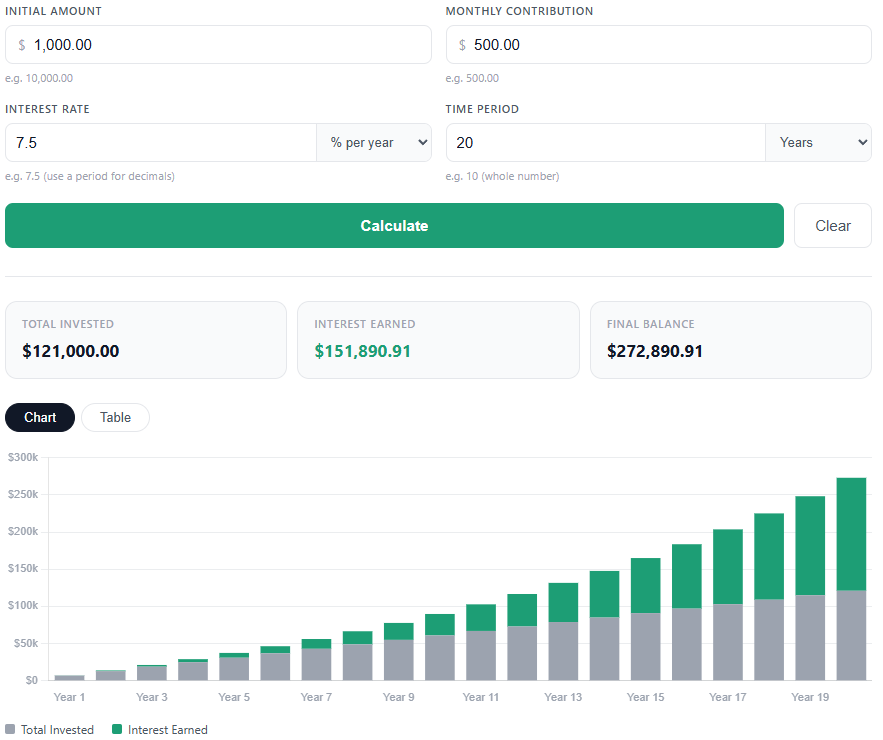
Our Compound Interest Calculator won’t help you short the British pound. But it does illustrate one of the core principles that Soros applied across his career: that compounding, whether from consistent investment or from a correctly positioned trade, produces results that initially seem implausible.
Frequently Asked Questions
Who is George Soros? George Soros (born György Schwartz, August 12, 1930, in Budapest, Hungary) is a Hungarian-American investor, hedge fund manager, philanthropist, and author. He is best known as the founder of the Quantum Fund, which averaged approximately 31% annual returns over thirty years, and for his $1 billion profit on Black Wednesday — September 16, 1992 — when his fund’s short position against the British pound succeeded after the UK was forced to withdraw from the European Exchange Rate Mechanism.
How much did George Soros make on the Bank of England trade? The Quantum Fund made approximately $1 billion in profit on September 16, 1992, from its short position against the British pound. Total profits from the surrounding period — as the position was built and subsequently closed — have been estimated at approximately $1.5 billion to $2 billion by various sources.
What is Black Wednesday? Black Wednesday refers to September 16, 1992, the day the United Kingdom was forced to withdraw from the European Exchange Rate Mechanism after the Bank of England spent approximately £3.4 billion trying and failing to support the pound within its required ERM band. The UK raised interest rates from 10% to 15% within a single morning before capitulating at 7:00 in the evening. Within a few years, the event was rebranded “Golden Wednesday” by some economists, as the devaluation allowed the Bank of England to cut rates and helped trigger Britain’s mid-1990s economic recovery.
What role did Druckenmiller play in the Soros trade? Stanley Druckenmiller, who was managing the Quantum Fund’s day-to-day portfolio at the time, identified the pound trade and built the initial position to approximately $7 billion. When he presented the situation to Soros, Soros told him the position was too small and instructed him to double it — to “go for the jugular.” The $10 billion position that resulted produced the $1 billion profit on Black Wednesday. Druckenmiller subsequently built his own remarkable investment record at Duquesne Capital.
What is George Soros’s theory of reflexivity? Reflexivity is Soros’s central investment philosophy concept: the idea that market participants’ perceptions are inherently biased and that those biased perceptions affect market prices, which in turn affect the underlying fundamentals that participants are assessing — creating self-reinforcing feedback loops that drive prices to extremes before eventually reversing. It is the intellectual framework behind the pound trade: as more traders shorted the pound, Britain’s position became harder to defend, making the eventual exit more inevitable, attracting more sellers, in a cycle that ended in Britain’s withdrawal from the ERM.
What is George Soros’s net worth? Soros’s personal net worth is estimated at approximately $6.7 billion. The figure is complicated by the fact that he has donated more than $32 billion through the Open Society Foundations and related organizations over his lifetime — making him one of the most significant philanthropists in modern history by the scale of total giving.
What happened to the Quantum Fund? The Quantum Fund continued operating after 1992 and maintained its extraordinary long-run record of approximately 31% annual returns through the end of the 1990s. After significant losses in technology stocks during the dot-com bubble in 1999 and 2000 — a period that also cost Druckenmiller his position — Soros restructured the fund and eventually converted it to a family office. The fund’s outside investors had their capital returned.
Sources and Further Reading
- Wikipedia — George Soros (primary biographical source): https://en.wikipedia.org/wiki/George_Soros
- Britannica Money — George Soros biography: https://www.britannica.com/money/George-Soros
- Open Society Foundations — George Soros biography (official): https://www.opensocietyfoundations.org/george-soros
- Market Histories — George Soros: The Man Who Broke the Bank of England (March 2026): https://www.markethistories.com/en/george-soros-the-man-who-broke-the-bank-of-england-1992
- History Defined — How George Soros Shorted the Pound and “Broke” the Bank of England: https://www.historydefined.net/how-george-soros-broke-the-bank-of-england/
- EBSCO Research Starters — George Soros biography: https://www.ebsco.com/research-starters/biography/george-soros
- Encyclopedia.com — George Soros 1930 (career timeline): https://www.encyclopedia.com/people/social-sciences-and-law/business-leaders/george-soros
- George Soros — The Alchemy of Finance (1987, Wiley) — primary source on reflexivity theory: https://amzn.to/4fXaVb1
- Sebastian Mallaby — More Money Than God (2010, Penguin) — chapter on Quantum Fund and Black Wednesday: https://amzn.to/4zdXTgQ
- Jack Schwager — The New Market Wizards (1992, HarperCollins) — includes Druckenmiller interview on the pound trade: https://amzn.to/4qhmFIL
- Investing Time Daily — Stan Druckenmiller’s Portfolio: 30 Years Without a Losing Year: https://investingtimedaily.com/stanley-druckenmiller-portfolio/
- Investing Time Daily — Jesse Livermore: The Man Who Made $100 Million in the 1929 Crash: https://investingtimedaily.com/jesse-livermore/
- Investing Time Daily — Compound Interest Calculator: https://investingtimedaily.com/calculators/compound-interest-calculator-free/
Disclosure: This post contains affiliate links. If you make a purchase through them, I may earn a small commission at no extra cost to you.