Howard Marks does not regularly publish a reading list. What exists instead are specific, verifiable moments: books he cited in his famous Oaktree Capital memos, an official 2023 year-end book list published directly by Oaktree Capital in which Marks participated, and occasional references in podcast appearances. Every book on this list traces to one of those sources. Books frequently attributed to Marks on third-party aggregator sites that lack a documentable primary source have been excluded.
Since 1990, Howard Marks has been writing memos to his clients at Oaktree Capital that Wall Street reads the way most people read market news: carefully, immediately, and more than once. Warren Buffett has said that he reads them as soon as they arrive. Marks is not known for television appearances or social media. He is known for his memos — 200 or so, written over three decades, each one an exercise in thinking clearly about risk, valuation, cycles, and investor psychology.
The books behind those memos reveal something about how Marks’ thinking has developed. He reads across disciplines — history, behavioral science, decision theory, mountaineering — and the connections he draws between those fields and financial markets are what make his memos distinctive. This list is built from the books he has cited in his own writing, in an official year-end recommendation he published through Oaktree Capital in 2023, and in a small number of documented public appearances.
Who is Howard Marks?
Howard Marks co-founded Oaktree Capital Management in 1995, following a career that included positions at Citibank and TCW. Under his leadership, Oaktree grew into one of the largest credit-focused investment firms in the world, managing over $180 billion in assets. The firm specializes in distressed debt and high-yield credit — areas where the margin between what something is worth and what you can buy it for is often widest, and where Marks’s framework of “second-level thinking” has been most consistently applied.
His two books — The Most Important Thing (2011) and Mastering the Market Cycle (2018) — are staples in the reading lists of serious investors. His memos, available freely on Oaktree’s website at oaktreecapital.com, represent one of the most sustained bodies of investment writing by any single practitioner still working. He remains active as co-chairman of Oaktree following ING Barings’ acquisition and subsequent restructuring of the firm.
The books that shaped his most famous memos
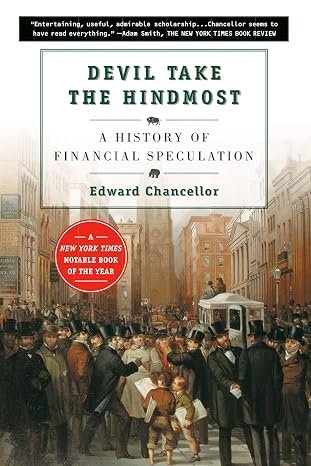
Devil Take the Hindmost: A History of Financial Speculation — Edward Chancellor
This is the book most directly tied to Marks’ documented record as a reader and a thinker. He read Devil Take the Hindmost in the fall of 1999, during the peak of the dot-com bubble. What he found was a history of speculative manias — tulip mania, the South Sea Bubble, the railroad booms of the 19th century, the market of the 1920s — documented in methodical, unsentimental detail by historian Edward Chancellor.
The experience of reading it prompted Marks to write the memo that became his most famous: “bubble.com,” dated January 2, 2000. In that memo, he argued explicitly that what markets were doing in 1999 and early 2000 reflected the same patterns he had just read about in Chancellor’s book. He was right. The Nasdaq peaked in March 2000 and fell approximately 78% over the following two and a half years.
In subsequent memos and appearances — including a reference in his 2024 “Easy Money” memo — Marks returned to Devil Take the Hindmost repeatedly, citing it as the foundational text for understanding how collective psychology drives prices away from value during speculative periods. He also recommended it in an August 2025 podcast appearance on My First Million, describing it as essential reading for anyone trying to understand how markets behave at extremes.
Few books in investment literature have been cited more specifically and more repeatedly in a practitioner’s own writing. The attribution here is unambiguous.
On Amazon: https://amzn.to/4hfX28A
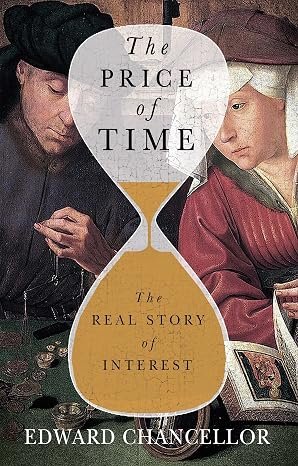
The Price of Time: The Real Story of Interest — Edward Chancellor
Chancellor published this history of interest rates in 2022, and Marks read it before writing his February 2024 memo “Easy Money” — one of the most comprehensive treatments of the role of artificially low interest rates in distorting investment behavior that he has produced.
In that memo, Marks cited Chancellor’s argument that manipulating the price of credit — keeping it artificially cheap — inevitably produces malinvestment, bubbles, and the eventual pain of normalization. The book traces the concept of interest through antiquity, through religious prohibitions, through the development of modern central banking, and into the near-zero rate environment of the 2010s.
For Marks, whose investing career has been built around credit markets and whose thinking about risk centers on price — specifically, on whether you’re being paid adequately for the risk you’re taking — a systematic history of how the price of money has been understood and manipulated across human history was the kind of book that directly feeds his work. He did not merely mention The Price of Time in passing. He wrote one of his most important memos specifically in response to it.
On Amazon: https://amzn.to/4ymsbNC
The 2023 Year-End Recommendations from Oaktree Capital
In December 2023, Howard Marks and the team at Oaktree Capital published an official list of ten year-end book recommendations, available directly from Oaktree’s website. Marks participated in compiling this list and provided personal commentary on each title. What follows are the ten books, along with the commentary he contributed — drawn directly from the Oaktree document.
This is a notable list for two reasons. First, it is not a financial reading list. Marks included a Japanese novel about a Tokyo café, a mountaineering memoir, and a history of the Roman Empire alongside books about decision-making and commodities trading. Second, the breadth of the list is itself a reflection of his stated investment philosophy: that good investors think across disciplines, and that patterns in history, psychology, and human behavior are more revealing than patterns in price charts.
1. Thinking in Bets: Making Smarter Decisions When You Don’t Have All the Facts — Annie Duke
Marks described this book as “a helpful guide for anyone contemplating how to make decisions when faced with imperfect information, uncertainty, and multiple possible outcomes. That’s why it’s so relevant to the world of investing.”
Annie Duke, a former professional poker player with a PhD in cognitive psychology, argues that good decision-making is not about certainty — it is about accurately assessing probabilities, updating beliefs when new information arrives, and separating a decision’s quality from its outcome. A bad decision can produce a good result by luck; a good decision can produce a bad result for the same reason. Most people confuse the two.
For Marks, whose memos consistently address investor psychology and the tendency of markets to swing between overconfidence and excessive fear, the connection is direct: his concept of “second-level thinking” requires exactly the kind of probabilistic reasoning Duke describes.
On Amazon: https://amzn.to/4rS2kuJ

2. The Fate of Rome: Climate, Disease, and the End of an Empire — Kyle Harper
Marks noted: “This fascinating book offers an illuminating take on some of the lesser-known factors that contributed to the downfall of the Roman Empire. While climate change and pandemics are top of mind today, I hadn’t fully appreciated their historical import until I read this book.”
Harper argues that the late Roman Empire was weakened not only by military pressure and political dysfunction but by climate deterioration and pandemic disease — factors that made the underlying system more fragile and less able to absorb the shocks it faced. Marks, who has written extensively about how leverage and overconfidence create fragility in financial systems, found the framework applicable beyond ancient history.
On Amazon: https://amzn.to/4yolxGQ

3. Stay True — Hua Hsu
“Stay True is a beautifully written memoir about friendship and loss set in Northern California in the mid-1990s,” Marks wrote. “The book highlights the ways young adults seek to cultivate their images — sometimes in less than fully authentic ways — and the miracle of finding a friend who can see you for who you really are.”
This is the most personal inclusion on the list — a memoir that won the Pulitzer Prize for Memoir or Autobiography in 2023. Its appearance here reflects a dimension of Marks’ reading that investment-focused commentators often miss: he reads literature.
On Amazon: https://amzn.to/4yXgyN1

4. Clear Thinking: Turning Ordinary Moments into Extraordinary Results — Shane Parrish
Marks described this as a book that “provides readers with insights and practical tools that can help them learn how to think and act more deliberately… he seeks to help readers turn off their mental autopilots, reset their default settings, and improve their decision-making in both their personal and professional lives.”
Shane Parrish, who runs the Farnam Street blog and podcast, draws on psychology, philosophy, and practical experience to argue that most mistakes aren’t made in unusual situations — they’re made in ordinary moments when our default mental habits take over without our noticing. This connects directly to Marks’ long-standing interest in investor psychology and how cognitive biases produce market inefficiencies that disciplined investors can exploit.
On Amazon: https://amzn.to/4yXMiBw

5. The World for Sale: Money, Power, and the Traders Who Barter the Earth’s Resources — Javier Blas and Jack Farchy
“I’ve always enjoyed reading about the genesis of an industry,” Marks wrote. “The World for Sale offers such a story in its exploration of the history and inner workings of the often poorly understood commodities trading market. On a more personal note, I once had a job interview with a key figure in the book.”
Blas and Farchy trace the rise of the major commodities trading houses — Vitol, Glencore, Trafigura, Gunvor — that sit between the world’s resource producers and its consumers, largely invisible to most investors despite controlling enormous flows of oil, metals, and agricultural commodities. The personal connection Marks mentioned adds an element of autobiography to an otherwise analytical read.
On Amazon: https://amzn.to/4rxj75X

6. The Boardman Tasker Omnibus — Joe Tasker and Peter Boardman
“While I have no desire to climb a mountain, I’ve become fascinated by what motivates those who do,” Marks wrote. “This 890-page omnibus combines four books written by two of mountaineering’s great pioneers, both of whom tragically lost their lives while pursuing their passion. While their risk calculations were far more gut-led than what you would want in a credit investor, I respect the fact that they were meticulous planners who strove to do everything they could to summit, descend, and survive.”
The commentary reveals something important about Marks: he connects risk management in extreme physical pursuits to risk management in investment. Both require planning, respect for uncertainty, and the discipline to stop when conditions change. Both Tasker and Boardman died on Everest in 1982.
On Amazon: https://amzn.to/3T5Z3ej

7. The Caliph’s House: A Year in Casablanca — Tahir Shah
“I also found valuable parallels to investing,” Marks wrote of this memoir, “including the wisdom of taking smart risks, the challenges of negotiating with unfamiliar counterparties, and the importance of giving oneself time for reflection.”
Shah’s account of buying a crumbling Casablanca mansion and spending a year restoring it is a travel memoir, not an investment book. Yet Marks found the decision-making structure familiar: the due diligence failures, the unexpected complications, the moments where stopping would have been rational but the longer-term case remained compelling.
On Amazon: https://amzn.to/4xKDyxG

8. Trillion Dollar Triage — Nick Timiraos
Marks explained: “I first heard about Trillion Dollar Triage when it was referenced by Warren Buffett in an interview he gave on CNBC earlier this year. The book provides a detailed play-by-play on the actions taken by the Treasury, the Federal Reserve, and the White House from the lead in through the aftermath of the pandemic.”
Timiraos, the Federal Reserve reporter for The Wall Street Journal, reconstructs the real-time decision-making process that produced the Fed’s extraordinary interventions in March 2020 — the rate cuts to zero, the unlimited bond-buying, the emergency lending facilities. For Marks, whose “Easy Money” memo directly addresses the consequences of those decisions, this is essential primary source material for understanding the decade that followed.
On Amazon: https://amzn.to/4xOIEcp

9. Before the Coffee Gets Cold — Toshikazu Kawaguchi
“I absolutely loved this book!” Marks wrote. “Before the Coffee Gets Cold is a delightful exploration of time travel and human connections set in a charming Tokyo café. I felt a deep connection with the characters, whose stories are as heartwarming as they are thought-provoking. I recommend this book for anyone who craves a soulful and introspective literary journey.”
This Japanese novel — a bestseller in Japan before being translated into dozens of languages — involves visitors to a particular Tokyo café who can travel back in time to a single moment, but only while their coffee is hot. It is entirely unlike the rest of this list. Its inclusion says something about Marks as a reader: he does not compartmentalize his reading by subject.
On Amazon: https://amzn.to/4ABgdBf

10. Outlive: The Science and Art of Longevity — Peter Attia with Bill Gifford
Marks concluded the list with a health book: “Dr. Peter Attia argues that the true emphasis should shift toward preventing [age-related] diseases in order to extend healthspan… This book serves as a compelling reminder of the central role of exercise in promoting longevity and encourages us to rethink our approach to long-term health.”
Attia’s book argues that mainstream medicine focuses too late in the disease process and that the most effective interventions happen decades before symptoms appear. The parallel to investing is not explicit in Marks’ commentary, but it maps onto his broader point about long-term thinking: the decisions that matter most are the ones made before the problem becomes visible.
On Amazon: https://amzn.to/4hqWYSh

From a 2025 podcast: Simple But Not Easy
In an August 2025 appearance on the podcast My First Million, Marks recommended Simple But Not Easy: An Autobiographical and Biased Book About Investing by Richard Oldfield, noting that Oldfield is a personal friend. The book is a candid, personal account of a career in professional investment management — making mistakes, learning from them, and arriving at a set of principles that are, as the title suggests, easier to articulate than to execute. Marks’ endorsement here is personal rather than systematic, which makes it notable in a different way from the formal recommendations above.
Howard Marks’ own books: the essential reading list for new readers
Before any of the books above, readers who are new to Marks’ thinking should start with his own work.
The Most Important Thing: Uncommon Sense for the Thoughtful Investor (2011) collects the core of what he has spent three decades arguing: that superior investing requires second-level thinking, rigorous assessment of risk (not just return), understanding where we are in the market cycle, and the discipline to act — or not act — accordingly. A later edition, The Most Important Thing Illuminated (2013), adds commentary from Joel Greenblatt, Christopher Davis, Paul Johnson, and Seth Klarman.
Mastering the Market Cycle: Getting the Odds on Your Side (2018) deepens one specific theme from the first book: how to recognize where the cycle is and adjust behavior accordingly. Marks does not claim to predict market timing with precision. He argues that understanding the cycle — credit availability, investor psychology, valuation levels, risk appetite — allows an investor to shift the odds in their favor without needing to know exactly when the turn will come.
Both books are among the most cited in our own article on the best books about investing.
Reading order: where to start
If you are new to Marks’ work, start here:
The Most Important Thing → Devil Take the Hindmost → Thinking in Bets → Mastering the Market Cycle → The Price of Time
This sequence moves from Marks’ own framework, to the historical context that most shaped it, to the behavioral science that explains why markets repeatedly fail to apply it, back to Marks’ most fully developed statement of how cycles work, and finally to the macro backdrop that connects low interest rates to the specific distortions he has spent the last decade analyzing.
Then read the memos — all of them, chronologically, starting from the earliest available on oaktreecapital.com. The progression of his thinking across decades is itself an education.
Frequently Asked Questions
What books does Howard Marks recommend? The most documented books Marks has recommended are Devil Take the Hindmost by Edward Chancellor — cited in his “bubble.com” memo from January 2000 and repeatedly since — and The Price of Time, also by Chancellor, cited in his “Easy Money” memo from 2024. In December 2023, Oaktree Capital published an official year-end book list in which Marks participated, including ten titles across investing, history, decision-making, and literature. In August 2025, he recommended Simple But Not Easy by Richard Oldfield in a podcast appearance.
What is Howard Marks most famous book? Marks is the author of The Most Important Thing: Uncommon Sense for the Thoughtful Investor (2011), which is widely considered one of the best books on investment philosophy available. His second book, Mastering the Market Cycle (2018), develops the specific theme of recognizing and responding to the natural cycles of financial markets.
Why did Howard Marks recommend Devil Take the Hindmost? Marks read Devil Take the Hindmost by Edward Chancellor in the fall of 1999, during the peak of the dot-com bubble. The book’s detailed history of speculative manias — from tulip mania to the South Sea Bubble to the 1920s — prompted him to write his most famous memo, “bubble.com,” in January 2000, arguing that markets were exhibiting the same patterns documented in Chancellor’s history. The Nasdaq peaked in March 2000 and subsequently fell approximately 78%.
What is Howard Marks’ reading style? His 2023 year-end list suggests that Marks reads well beyond finance — he included a Japanese novel, a mountaineering memoir, and a history of the Roman Empire alongside books about commodities trading and decision science. This mirrors what he has described in his memos as the value of thinking across disciplines: patterns in human behavior, history, and psychology appear in financial markets in recognizable forms, and a reader who only reads investment books sees only part of the picture.
What is the difference between Howard Marks’ books and his memos? The books are more structured and systematic — The Most Important Thing presents his full investment philosophy, and Mastering the Market Cycle develops a single theme in depth. The memos, published on Oaktree Capital’s website at oaktreecapital.com, are more topical and reactive — Marks writes them when he has something specific to say about conditions, events, or ideas that seem important. The memos are free to access and, for many readers, the more revealing document of how his thinking actually works.
Has Howard Marks published a comprehensive recommended reading list? No. Unlike some investors who have published extensive or structured reading lists, Marks’ documented book recommendations are relatively sparse and come from specific contexts: books cited in his own memos, the 2023 Oaktree year-end list, and occasional podcast mentions. This article includes only books with a verifiable primary source. We have intentionally excluded titles that appear on third-party aggregator sites attributed to Marks without documentation.
Sources and Further Reading
- Oaktree Capital Management — Howard Marks memo “bubble.com” (January 2, 2000): https://www.oaktreecapital.com/insights/memo/bubble-com
- Oaktree Capital Management — Howard Marks memo “Easy Money” (February 2024): https://www.oaktreecapital.com/insights/memo/easy-money
- Oaktree Capital Management — 2023 Year-End Book Recommendations (official PDF, includes Marks’ personal commentary): https://www.oaktreecapital.com/docs/default-source/default-document-library/2023-year-end-book-recommendations.pdf
- Oaktree Capital Management — All memos by Howard Marks (complete archive): https://www.oaktreecapital.com/insights/memos
- The Acquirer’s Multiple — Howard Marks: 10 Year-End Book Recommendations 2023 (full list with commentary): https://acquirersmultiple.com/2023/12/howard-marks-10-year-end-book-recommendations-2023/
- My First Million Podcast — Howard Marks appearance (August 2025, source of Simple But Not Easy recommendation): https://www.mfmpod.com
- Edward Chancellor — Devil Take the Hindmost: A History of Financial Speculation (2000, Plume): https://amzn.to/4hfX28A
- Edward Chancellor — The Price of Time: The Real Story of Interest (2022, Atlantic Monthly Press): https://amzn.to/4ymsbNC
- Annie Duke — Thinking in Bets: Making Smarter Decisions When You Don’t Have All the Facts (2018, Portfolio): https://amzn.to/4rS2kuJ
- Howard Marks — The Most Important Thing: Uncommon Sense for the Thoughtful Investor (2011, Columbia University Press): https://amzn.to/3TmiuQ7
- Howard Marks — Mastering the Market Cycle: Getting the Odds on Your Side (2018, Houghton Mifflin Harcourt): https://amzn.to/4iKcQ4y
- Richard Oldfield — Simple But Not Easy: An Autobiographical and Biased Book About Investing (2007, Doddington): https://amzn.to/4dFLSHP
- Investing Time Daily — The Best Books About Investing: https://investingtimedaily.com/best-books-about-investing/
- Investing Time Daily — Charlie Munger’s Recommended Books: https://investingtimedaily.com/charlie-munger-recommended-books/
- Investing Time Daily — Ray Dalio’s Portfolio: Bridgewater, His Family Office, and the All Weather Strategy: https://investingtimedaily.com/ray-dalio-portfolio/
Disclosure: This post contains affiliate links. If you buy through them, I may earn a commission at no extra cost to you