In August 2025, Ray Dalio completed a transition he had been planning for over a decade: he sold his last remaining stake in Bridgewater Associates, the hedge fund he founded in a two-bedroom Manhattan apartment in 1975, and walked away from its board entirely. A few months later, for the first time since the pandemic, his family office filed its own 13F report with the SEC — revealing a personal portfolio that looks nothing like what most people associate with his name.
This article separates three things that are routinely blurred in coverage of Dalio: the institutional portfolio his former firm Bridgewater now runs, the personal portfolio he manages for himself at the Dalio Family Office, and the All Weather strategy — the framework designed to survive any economic environment, which any individual investor can build. Each is different. Each is worth understanding on its own terms.
Who is Ray Dalio?
Ray Dalio was born in 1949 and grew up in a middle-class neighborhood in Long Island, New York, the son of a jazz musician and a homemaker. He started investing at 12, caddying at a golf club and using his tips to buy shares of Northeast Airlines for $300 — a lucky first trade that tripled when the airline merged. He studied finance at Long Island University and earned an MBA from Harvard Business School, then traded commodity futures at Merrill Lynch before founding Bridgewater Associates in 1975, at age 26, from his apartment.
The early years weren’t smooth. In 1982, after watching Mexico default on its debt, Dalio became convinced a global depression was imminent. He testified before Congress. He appeared on television. He was completely, catastrophically wrong. The U.S. economy instead entered one of the longest booms in its history. He had to lay off all of his staff, and at one point borrowed $4,000 from his father just to cover household expenses.
That failure — which he has described as the most important event of his career — pushed him to build what he calls a systematic, principles-based approach to decision-making: writing down the logic behind every investment conclusion, stress-testing it against history, and requiring the best idea to win regardless of whose it was. Those principles eventually became the foundation of Bridgewater’s culture, and later a 2017 book, Principles: Life and Work, which sold over 5 million copies. He followed it with Principles for Dealing with the Changing World Order in 2021 and The Big Cycle in 2025.
Under his leadership, Bridgewater achieved what few investment firms ever have: consistent, long-term outperformance across wildly different market environments. It predicted the 2008 financial crisis a year in advance and earned positive returns while many peers lost 30% or more. In 2011, it recorded the largest annual profit in hedge fund history — approximately $13.8 billion. At its peak, Bridgewater managed roughly $160 billion across more than 150 markets for institutional clients including sovereign wealth funds, pension funds, university endowments, and central banks.
Dalio gradually reduced his operational role over several years: stepping down as CEO in 2017, as co-CIO in 2022, and finally selling his remaining equity stake and resigning from the board in August 2025. His net worth is estimated at approximately $20.1 billion, according to the Bloomberg Billionaires Index. He has donated more than $7 billion through Dalio Philanthropies since 2003, with a particular focus on ocean exploration through OceanX, public education, and mental health research.
The distinction that almost every article gets wrong
Before discussing what Dalio holds, it’s worth being precise about the terminology — because almost every article about “Ray Dalio’s portfolio” conflates at least two different things, and many conflate three.
Bridgewater Associates: the hedge fund Dalio founded, which now manages approximately $92 billion. Since August 2025, it is run entirely by a new generation of co-CIOs — Karen Karniol-Tambour, Bob Prince, and Greg Jensen. Dalio no longer makes investment decisions there. Bridgewater still files quarterly 13F reports with the SEC, which remain the most widely cited data source for “what Ray Dalio owns.” They are no longer that.
The Dalio Family Office: Dalio’s personal investment vehicle, which manages his own fortune. Since late 2025, Dalio has been directly overseeing this operation as its own CIO — his description — with the help of Steven Kryger, a former Bridgewater executive, and a small global macro team. The family office filed its own 13F for the first time since the pandemic in early 2026, covering holdings as of year-end 2025. That is the closest thing to “Ray Dalio’s personal portfolio” that exists in any public document.
The All Weather Portfolio: a framework Dalio developed for how to allocate capital across asset classes to perform reasonably in any economic environment. This is neither a fund nor a personal account — it’s a strategy description he has shared publicly and that any investor can implement. Bridgewater runs its own institutional version with leverage and additional instruments; the publicly described allocation is a simplified, investable version.
Bridgewater’s Q1 2026 portfolio
Bridgewater filed its Q1 2026 13F with the SEC on May 15, 2026, covering holdings as of March 31, 2026. The equity portfolio disclosed is valued at approximately $22.4 billion across 993 holdings — a highly diversified, institutionally constructed book that reflects the firm’s current co-CIO team’s views, not Dalio’s.
The top five holdings by portfolio weight as of March 31, 2026:
| Holding | Ticker | Portfolio weight |
|---|---|---|
| SPDR S&P 500 ETF | SPY | 12.67% |
| iShares Core S&P 500 ETF | IVV | 7.81% |
| Amazon | AMZN | 4.08% |
| Nvidia | NVDA | 3.65% |
| Alphabet | GOOGL | 2.56% |
Together, the two S&P 500 index ETFs (SPY and IVV) represent over 20% of the disclosed portfolio — reinforcing Bridgewater’s broad-market, diversified approach rather than concentration in any single theme. Amazon entered the top five for the first time, with Bridgewater buying approximately $535 million worth of the stock in Q1.
Notable portfolio moves in Q1 2026: the firm initiated new positions in Taiwan Semiconductor (TSM), Alphabet (GOOG), Nucor (NUE), and PACCAR (PCAR). It completely exited Salesforce (CRM), Workday (WDAY), and ServiceNow (NOW) — a meaningful exit from enterprise software names. It significantly added to MongoDB (MDB), e.l.f. Beauty (ELF), and Hancock Whitney (HWC).
One caveat that applies to all 13F analysis: this filing discloses only long U.S.-listed equity positions, with a 45-day reporting delay. It doesn’t show short positions, non-U.S. holdings, derivatives, bonds, currencies, commodities, or any other instruments — a meaningful limitation for a firm whose strategy spans 150 global markets. The 13F is a partial window, not a complete picture. And again: these are decisions made by Bridgewater’s current team, not by Dalio.
Ray Dalio’s personal portfolio: the family office disclosure
The more revealing document — and the one most articles have missed — is the Dalio Family Office’s own 13F filing covering year-end 2025, submitted in early 2026. According to Bloomberg reporting on the filing, it showed a U.S. equity portfolio of approximately $503 million, up roughly a third from the last disclosure in early 2021.
The composition is strikingly different from Bridgewater’s diversified institutional book:
More than 75% of the disclosed portfolio is allocated to gold-based exchange-traded funds. The remainder is spread across U.S. government bond ETFs and ETFs tracking the S&P 500, plus some exposure to developed and emerging market ETFs.
In practical terms: the man who built the world’s largest hedge fund is personally holding mostly gold.
This isn’t a coincidence or a temporary position. It’s a direct expression of the macro thesis Dalio has been developing and publicly arguing for several years — and which he has articulated with increasing urgency throughout 2025 and 2026.
What Dalio is warning about in 2026
Since completing his exit from Bridgewater, Dalio has been more publicly outspoken than at any point in his career. His warnings center on three interlocking concerns:
U.S. debt on an unsustainable trajectory
Dalio has described the U.S. fiscal situation in stark terms, warning in early 2025 of a “debt death spiral” — a phase in which a borrower must borrow new money specifically to service existing debt, which then accelerates the cycle. He has pointed to a structural mismatch: the U.S. government spends approximately $7 trillion annually while generating approximately $5 trillion in revenue, running a persistent 40% overspend. Interest payments on the national debt crossed $970 billion in fiscal 2025, according to the Peter G. Peterson Foundation, with the Congressional Budget Office projecting they will exceed $1 trillion in fiscal 2026 — roughly $20 billion per week.
His concern is not that the U.S. will formally default. It’s that the more likely response — printing money to cover obligations — will gradually erode the purchasing power of the dollar, distributing the pain across all holders of dollar-denominated assets over years and decades rather than in a sudden crisis. “My grandchildren and great-grandchildren not yet born are going to be paying off this debt in devalued dollars,” he told David Rubenstein in 2026.
The dollar’s reserve currency status under pressure
Dalio has argued for several years that the dollar’s role as the world’s primary reserve currency is in structural decline — accelerated by what he sees as unsustainable debt levels and the growing willingness of countries to hold alternatives. He has pointed to gold’s extraordinary performance — up approximately 65% in 2025, dramatically outpacing the S&P 500’s roughly 18% gain — as evidence of a global flight away from fiat currencies and toward real assets. Central banks, including China’s, have been reallocating reserves from U.S. Treasuries toward gold, a trend Dalio describes as a structural rather than cyclical shift.
A “particularly risky period” ahead
In a widely cited statement in mid-2026, Dalio specifically identified the period between the 2026 midterm elections and the 2028 presidential election as a “particularly risky period” — arguing that fiscal deficits will widen further ahead of elections, that demand for U.S. government bonds is declining as foreign holders grow wary of both returns and geopolitical risk, and that the political environment makes meaningful fiscal consolidation unlikely in the near term. He has compared the most probable outcome to the stagflationary environment of the 1970s — a period in which inflation remained elevated even as economic growth stagnated, making traditional portfolios of stocks and bonds simultaneously difficult.
In Fortune in May 2026, he described the current moment as a “heart attack” — a sharp, acute symptom of what he calls “a great turbulence” that will reshape the country’s economy over years.
The All Weather Portfolio: what any investor can actually implement
The All Weather Portfolio is the part of Dalio’s work that is most actionable for individual investors. It has nothing to do with Bridgewater’s current 13F or his personal family office — it’s a strategy framework he developed and has shared publicly over decades, designed around a specific insight:
No one can reliably predict what the economy will do next. What we can predict is that the economy will cycle through four environments — rising growth, falling growth, rising inflation, and falling inflation — and that different asset classes perform differently in each. Rather than betting on which environment is coming, the All Weather approach attempts to hold enough of each relevant asset class to perform reasonably across all four.
The publicly described allocation, in its classic form:
| Asset class | Allocation |
|---|---|
| U.S. stocks | 30% |
| Long-term Treasury bonds (20+ year) | 40% |
| Intermediate Treasury bonds (7–10 year) | 15% |
| Gold | 7.5% |
| Diversified commodities | 7.5% |
The logic behind each allocation:
Stocks (30%): outperform in periods of rising economic growth and corporate profit expansion.
Long-term bonds (40%): typically appreciate during economic slowdowns or deflation, when interest rates fall and investors seek safety. The large allocation reflects the fact that bonds, being less volatile than stocks, require a higher capital weight to contribute equally to the portfolio’s risk.
Intermediate bonds (15%): a more moderate duration position that bridges the gap between stability and yield.
Gold (7.5%): historically preserves purchasing power during inflationary periods and provides diversification that is genuinely uncorrelated with both stocks and bonds during financial stress.
Commodities (7.5%): also tend to perform during inflationary periods, providing additional protection against the environment that hurts both stocks and bonds simultaneously.
The key trade-off:
The All Weather Portfolio does not maximize returns — it minimizes deep drawdowns. Historically, it has delivered roughly half the volatility of the S&P 500, with significantly shallower peak-to-trough declines, at the cost of approximately 1 to 2 percentage points of long-run annual return compared to an all-equity portfolio.
Its structural vulnerability is a sustained equity bull market with low inflation — exactly the environment of the 2010s, when the S&P 500 dramatically outperformed. And it struggled significantly in 2022, when rising rates simultaneously hurt the large bond allocation and stocks fell, producing losses of approximately 18%. That year exposed a limitation Dalio’s framework was explicitly designed around: the heavy bond allocation is, in effect, a bet that interest rates and inflation remain well-behaved.
How to build it as an individual investor:
In its simplest ETF implementation, the All Weather Portfolio can be constructed with five funds:
- VTI or SPY — U.S. total stock market (30%)
- TLT — long-term Treasury bonds (40%)
- IEF — intermediate Treasury bonds (15%)
- GLD or IAU — gold (7.5%)
- DBC or PDBC — diversified commodities (7.5%)
An ETF called ALLW has been created specifically to track the strategy in a single fund, though its 0.85% annual expense ratio is meaningfully higher than building the equivalent allocation from its components.
What this means for individual investors
Whether or not Dalio’s macro thesis about U.S. debt and dollar decline proves correct in the timeframe he describes, the framework he has spent fifty years developing offers several ideas that are useful regardless of where you land on his specific predictions.
Risk parity is a different way to think about diversification. Most portfolios are diversified in dollar terms but not in risk terms — in a conventional 60/40 portfolio, equities are so much more volatile than bonds that they account for roughly 90% of the portfolio’s actual risk. Dalio’s insight that diversifying risk exposure, not just dollar allocation, leads to more genuinely balanced portfolios is supported by decades of empirical research and has influenced institutional investment management broadly.
Gold has historically performed a function that nothing else quite replicates. The All Weather allocation to gold is not based on a prediction that gold prices will rise — it’s based on the observation that gold has consistently provided protection in the specific scenario that is most dangerous for other asset classes: inflation combined with economic stress. Dalio’s personal 75% allocation to gold ETFs reflects a much stronger conviction than his public framework suggests — and it’s worth noting that gold’s 65% rise in 2025 validated at least the near-term direction of that conviction.
Consistency across environments is a different goal than maximizing returns. For many investors — especially those approaching or in retirement — avoiding deep drawdowns matters more than maximizing long-run average returns, because a large loss at the wrong moment can permanently impair a portfolio’s ability to recover. The All Weather strategy is explicitly designed for this goal.
Macro warnings are useful input, not actionable instructions. Dalio’s 2026 warnings about U.S. debt are thought-provoking and data-backed. They are also large-scale, long-horizon predictions about structural dynamics — the kind of view that can be right in direction but wrong in timing by years or decades. Dalio himself has been wrong before on macro calls (1982 being the most famous). Treating his warnings as one perspective among many, rather than as a precise trading signal, is the most rational response.
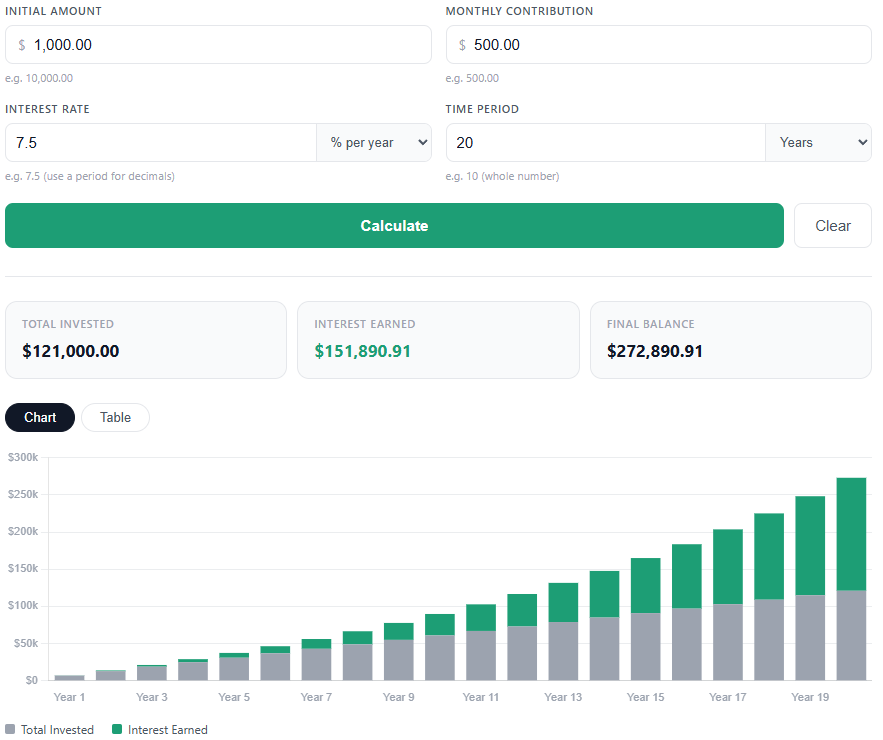
Want to see how different portfolio allocations affect long-term outcomes in your own numbers? Our Compound Interest Calculator lets you model the effect of different return assumptions — conservative, moderate, and optimistic — across 10, 20, and 30 year horizons.
Frequently Asked Questions
What is Ray Dalio’s current portfolio? There are three distinct things to track. The Dalio Family Office — his personal investment vehicle — disclosed a U.S. equity portfolio of approximately $503 million as of year-end 2025, with more than 75% allocated to gold ETFs. Bridgewater Associates, the fund he founded but fully exited in August 2025, holds a $22.4 billion equity portfolio led by S&P 500 ETFs (SPY and IVV), Amazon, Nvidia, and Alphabet as of Q1 2026. The All Weather Portfolio is a publicly shared framework, not a fund — any investor can implement it.
Does Ray Dalio still run Bridgewater Associates? No. Dalio sold his final remaining stake in Bridgewater in August 2025 and resigned from the board, completing a transition he began in 2017. The fund is now run by co-CIOs Karen Karniol-Tambour, Bob Prince, and Greg Jensen. Dalio remains a significant investor in Bridgewater’s strategies and an informal mentor, but no longer makes investment decisions for the firm.
What is the All Weather Portfolio? A strategy Dalio developed to hold assets in proportions that perform reasonably across all four major economic environments (rising growth, falling growth, rising inflation, falling inflation). The classic allocation is 30% U.S. stocks, 40% long-term Treasury bonds, 15% intermediate Treasury bonds, 7.5% gold, and 7.5% commodities. It prioritizes avoiding deep losses over maximizing returns.
Why does Ray Dalio’s personal portfolio hold so much gold? Dalio’s personal family office disclosure showed more than 75% of his U.S. equity portfolio in gold ETFs — a direct reflection of his macro thesis that U.S. debt levels are unsustainable, the dollar’s reserve currency status is declining, and fiat currencies broadly are losing purchasing power against real assets. Gold surged approximately 65% in 2025, outpacing the S&P 500’s roughly 18% gain, which he has cited as evidence of this thesis playing out.
What is Ray Dalio warning about in 2026? Dalio has warned that the U.S. is entering a “particularly risky period” driven by three forces: a national debt trajectory he describes as a “debt death spiral” (the U.S. spends roughly $7 trillion annually but generates only $5 trillion in revenue), a structural decline in demand for U.S. Treasuries from foreign holders, and a political environment unlikely to produce meaningful fiscal consolidation. He compares the most probable outcome to the stagflationary 1970s, and has recommended increasing allocation to gold and real assets as protection.
Has the All Weather Portfolio worked historically? The All Weather strategy has historically delivered roughly half the volatility of the S&P 500 with shallower drawdowns, at the cost of 1 to 2 percentage points of long-run annual return. However, it struggled significantly in 2022, losing approximately 18% as rising interest rates simultaneously hurt its large bond allocation and stocks fell — a reminder that no strategy performs well in every environment. Its heavy bond allocation also meant it underperformed meaningfully during the low-inflation bull market of the 2010s.
How much is Ray Dalio worth? According to the Bloomberg Billionaires Index, Dalio’s net worth is approximately $20.1 billion. He has donated more than $7 billion through Dalio Philanthropies since 2003.
Sources and Further Reading
- Bloomberg / IDNFinancials — Ray Dalio leaves Bridgewater, stashes $500 million in stock market; family office reveals gold-heavy portfolio: https://www.idnfinancials.com/news/61549/ray-dalio-leaves-bridgewater-to-stash-500-million-in-the-stock-market
- CNBC — Ray Dalio sells his last remaining stake in Bridgewater, steps away from board: https://www.cnbc.com/2025/08/01/ray-dalio-sells-his-last-remaining-stake-in-bridgewater-steps-away-from-hedge-funds-board.html
- Reuters — Bridgewater founder Ray Dalio sells remaining stake in hedge fund: https://finance.yahoo.com/news/ray-dalio-sells-remaining-stake-214411051.html
- Crain Currency — Ray Dalio embraces family office life as CIO: “I’m the guy” now: https://www.craincurrency.com/family-office-management/ray-dalio-embraces-family-office-life-cio-im-guy-now
- Fortune — Ray Dalio: the “heart attack” of America’s debt crisis is just the beginning of “great turbulence”: https://fortune.com/2026/05/08/ray-dalio-america-national-debt-reshape-economy-heart-attack/
- New Kerala / New York Post — Ray Dalio warns US entering “particularly risky period”: https://www.newkerala.com/news/a/us-entering-particularly-risky-period-amid-rising-debt-788.htm
- SEC / Fintel — Bridgewater Associates 13F filing Q1 2026 (filed 2026-05-15): https://fintel.io/i/bridgewater-associates-lp
- Insider Edges — Bridgewater Associates 13F portfolio tracker: https://www.insideredges.com/investor/ray-dalio-bridgewater-associates-lp
- Hedge Fund Alpha — Ray Dalio Portfolio: Bridgewater Top Holdings Q1 2026: https://hedgefundalpha.com/strategies/ray-dalio-portfolio/
- PortfoliosLab — Ray Dalio All Weather Portfolio performance and allocation: https://portfolioslab.com/portfolio/ray-dalio-all-weather
- Portfolio Crunch — Ray Dalio All Weather Portfolio: Risk-Balanced Allocation: https://portfoliocrunch.com/portfolios/ray-dalio-all-weather
- Bridgewater Associates — Our Founder (Ray Dalio biography): https://www.bridgewater.com/our-founder
- Forbes — Ray Dalio profile: https://www.forbes.com/profile/ray-dalio/
- Investing Time Daily — Michael Burry’s Portfolio: What Is He Betting Against in 2026?: https://investingtimedaily.com/michael-burry-portfolio-2026/
- Investing Time Daily — Compound Interest Calculator: https://investingtimedaily.com/calculators/compound-interest-calculator-free/