
Between 1988 and 2018, the Medallion Fund at Renaissance Technologies delivered an average annual return of 66.1% before fees — or 39.1% after the firm’s fees of 5% management and 44% performance. No other investment fund in history, across any strategy, over any comparable time period, has produced a documented record remotely close to those numbers. Warren Buffett averaged approximately 20% annually over his career. Peter Lynch averaged 29.2% over 13 years. The Medallion Fund, over 30 years, averaged nearly twice Lynch’s number.
The man behind it never wore socks, smoked up to two packs of cigarettes a day, kept his methods completely secret, and spent his life giving billions of dollars to mathematics and science.
Jim Simons died on May 10, 2024, in New York City, at age 86. He left behind the most extraordinary trading record in the history of organized markets — and almost no public explanation of how he achieved it.
From Brookline to Bogotá: the early years
James Harris Simons was born on April 25, 1938, in Cambridge, Massachusetts, and grew up in the nearby suburb of Brookline. He was the only child of Matthew and Marcia Simons. His father worked as a sales representative for 20th Century Fox before helping manage his father-in-law’s shoe factory.
Simons was drawn to mathematics before he could articulate why. He finished Newton High School in three years and enrolled at the Massachusetts Institute of Technology, where he earned a bachelor’s degree in mathematics in 1958 — completing the program in just three years. After graduating, he did something characteristic of how he operated throughout his life: he drove a motor scooter from Boston to Bogotá, Colombia. Then he came back and went to graduate school.
He earned his PhD in mathematics from the University of California, Berkeley, in 1961, at age 23, under the supervision of Bertram Kostant. His doctoral thesis gave a new proof of the Berger classification of holonomy groups of Riemannian manifolds — technically demanding work in differential geometry. He was awarded the Oswald Veblen Prize in Geometry by the American Mathematical Society in 1976, one of the most prestigious honors in his field.
During his PhD years in San Francisco, he walked into a Merrill Lynch office and placed his first trade — in soybean futures. It was the beginning of a curiosity that would define the second half of his life.
Breaking Soviet codes — and losing his job for opposing the war
In 1964, Simons accepted a position at the Institute for Defense Analyses (IDA) in Princeton, New Jersey, a nonprofit research organization that supported the National Security Agency in breaking codes used by the Soviet Union during the Cold War. The work introduced him to what algorithms and computers could do when applied to the search for patterns in complex datasets. IDA employees were permitted to spend half their time on personal research, and Simons used some of that time to study short-term movements in financial markets.
He worked at IDA for more than three years. In 1967 or 1968, he wrote a letter to Newsweek magazine opposing the Vietnam War — specifically challenging the positions of IDA’s president, Army General Maxwell D. Taylor. The institute asked him to leave. He was fired for his public opposition to the war.
He was 29. He had been one of the most productive mathematicians of his generation, had spent three years breaking Soviet codes, and had just lost his job for writing a letter to a magazine.
He was hired to chair the mathematics department at Stony Brook University on Long Island, New York. He held the position from 1968 to 1978.
The Chern-Simons theory and a life-changing question in a library
At Stony Brook, Simons continued doing serious mathematics. Working with the geometer Shiing-Shen Chern, he developed what became known as the Chern-Simons form, described in a 1974 paper. The theory provides mathematical tools — known as invariants — that mathematicians use to distinguish between certain curved spaces. It was later recognized as having profound implications for theoretical physics, connecting differential geometry and topology with quantum field theory and contributing to the development of string theory.
But something had been unsettling Simons since his MIT years. He remembered sitting in the library one day at MIT and thinking: “I’m going to become an assistant professor, then an associate professor, then a full professor, and then I’ll spend my life this way, and then I’ll die.” As he described it in a 2020 interview at the American Institute of Physics: “And that made me think that maybe there are other things in the world.”
By the mid-1970s, he had started trading currencies on the side. His initial approach used the same fundamental analysis most investors used — studying supply and demand — and he found the process agonizing. He called on colleagues from his IDA code-breaking days, including mathematicians Leonard Baum and Elwyn Berlekamp, to help him find a different approach. The question he asked them was simple: was there a mathematical way to predict price movements?
In 1978, at 40 years old, Simons left academia permanently to pursue the answer.
Renaissance Technologies and the Medallion Fund
Simons founded a predecessor firm he called Monemetrics, which he later renamed Renaissance Technologies. He began building quantitative models for trading currencies, then extended those models to commodity futures when his team concluded that the statistical patterns appeared consistently across different markets.
He established the Medallion Fund in 1988, naming it after the prestigious mathematics awards he and early collaborator James Ax had won. The first two years of the fund produced mixed results. But in 1990, after the team shifted its focus entirely to short-term trading strategies, the Medallion Fund returned 56%, net of fees. According to the InfoMoney obituary based on Bloomberg reporting, its performance never fell meaningfully after that.
The methods Simons used have never been fully disclosed, and Renaissance has gone to extraordinary lengths to keep them secret. What is publicly known:
Simons refused to hire Wall Street veterans. He recruited mathematicians, physicists, astrophysicists, astronomers, and code-breakers — people trained to find patterns in data rather than to analyze balance sheets or predict economic cycles. As described in the InfoMoney reporting on his death, he sought people who could “discover investable information in the terabytes of data that his company captured every day about everything, from sunspots to the weather outside.”
Simons once described his approach in a 2015 interview with the Numberphile channel: “Perhaps there were some ways to predict prices statistically.” He added: “Gradually, we built models.”
In his rare public appearances, he was consistent on one point about his investing philosophy: he never overrode the model. Whatever the algorithm said to do, the fund did. Human judgment — the emotional responses to fear and greed that characterize almost every other investment approach — was deliberately excluded.
The numbers: what the Medallion Fund actually produced
The performance of the Medallion Fund from its inception through the published data is documented in Gregory Zuckerman’s 2019 book The Man Who Solved the Market and confirmed by Wikipedia, drawing on Zuckerman’s research:
From 1988 to 2018, the Medallion Fund averaged 66.1% per year before fees and 39.1% per year after fees. Over that same 30-year period, the S&P 500 returned approximately 10% per year. The difference, compounded over decades, is not merely large — it is historically unprecedented. The fund earned over $100 billion in trading profits since its inception.
In 2008, when most hedge funds were losing 20% or more and the S&P 500 fell 37%, the Medallion Fund gained 80%.
In 2020, while the broader markets experienced extreme volatility from the COVID-19 pandemic, the Medallion Fund returned 76%.
After 1993, Simons stopped accepting new outside investors in the Medallion Fund. After 2005, he removed outside investors entirely. Only current and former Renaissance employees and their families could invest. He limited the fund’s total size to approximately $10 billion, returning profits to investors regularly, because he believed the strategies would lose their effectiveness if the fund grew too large. The fees — 5% management and 44% of profits — were among the highest in the industry, and investors paid them without complaint for as long as they were permitted to remain.
The performance gap: what outside investors actually received
One of the more uncomfortable facts about Renaissance Technologies is the enormous gap between what the Medallion Fund delivered and what the firm’s publicly available funds returned.
Renaissance offered three funds to outside investors — the Renaissance Institutional Equities Fund (RIEF), the Renaissance Institutional Diversified Alpha (RIDA), and the Renaissance Institutional Diversified Global Equity Fund. These funds were run by the same firm using ostensibly similar quantitative approaches, but their results bore almost no resemblance to the Medallion Fund.
In 2008, the year the Medallion Fund gained 80%, the RIEF lost 16%. In 2020, the year Medallion returned 76%, the other Renaissance funds lost money in double digits.
The reasons for this gap were never fully explained by the firm. Theories advanced by analysts included the different asset classes traded, the different time horizons used, and the possibility that the most effective Medallion strategies simply could not be scaled to the larger capital pools in the public funds. Simons was questioned by investors about this disparity at a May 2009 meeting, as reported by The Wall Street Journal.
Whatever the explanation, the record is clear: the greatest investing record in history was available only to those who worked at Renaissance Technologies. Outside investors received a very different experience.
The tax controversy
Simons’s record attracted scrutiny beyond the financial press.
On July 22, 2014, the U.S. Senate Permanent Subcommittee on Investigations issued a bipartisan condemnation of Renaissance Technologies for using complex “basket option” structures to reclassify day-to-day trading gains — normally taxed as ordinary income — as long-term capital gains, which carry lower tax rates. Senator John McCain said in his opening statement that “Renaissance Technologies was able to avoid paying more than $6 billion in taxes by disguising its day-to-day stock trades as long term investments.”
The New York Times reported in December 2015 that Renaissance remained under IRS review for a tax loophole estimated to have saved the fund approximately $6.8 billion over roughly a decade.
In September 2021, it was announced that Simons and his colleagues at Renaissance would pay billions of dollars in back taxes, interest, and penalties to resolve the dispute — one of the largest IRS settlements in American history.
The outcome of the dispute has no direct bearing on the legitimacy of the Medallion Fund’s trading returns, which have not been disputed. It is relevant context for understanding the full picture of how the firm operated and how its profits were structured.
The man behind the mathematics
Simons was, by almost all accounts, a genuinely unusual human being.
He did not wear socks — a habit he reportedly shared with Albert Einstein, and which he maintained through business meetings, academic conferences, and Senate hearings alike. He smoked up to two packs of Merit cigarettes per day, a habit he never abandoned. He owned a motor yacht he named Archimedes, after the ancient Greek mathematician. He shunned the press with a dedication unusual even for hedge fund managers, rarely giving interviews and never explaining his methods. When asked about publicity, he quoted Benjamin the Donkey from George Orwell’s Animal Farm: “God gave me a tail to keep off the flies. But I’d rather have had no tail and no flies.”
When the Securities and Exchange Commission visited Renaissance after the Bernard Madoff Ponzi scheme was revealed in 2008, Simons described the encounter at an MIT event in 2019: “They studied us. Of course, they found nothing.”
He organized annual trips for his employees and their families — to Bermuda, the Dominican Republic, Florida, Vermont — and built Renaissance into something more like a research community than a conventional financial firm. “It’s an open atmosphere,” he told an MIT audience in 2010. “We make sure everyone knows what everyone is doing, the sooner the better. That’s what stimulates people.”
He was fond of a particular formulation about what drew him to markets: “It’s easier to predict the path of a comet than the path of Citigroup stock. The attraction, of course, is that you can make more money predicting a stock than a comet.”
Personal tragedy
Simons had five children from two marriages. His first wife was Barbara Bluestein, whom he married in 1959 and divorced in the mid-1970s. They had three children together: Nathaniel, Liz, and Paul. His second wife, Marilyn Hawrys, whom he married in 1977, remained with him until his death. Together they had two children: Nick and Audrey.
Two of his children did not survive him.
In 1996, his son Paul, then 34, was struck and killed by a car while riding his bicycle on Long Island. In memory of Paul, Simons established the Avalon Nature Preserve, a 130-acre preserve in Stony Brook, New York.
In 2003, his son Nick, then 24, drowned while on a trip to Bali, Indonesia. Nick had worked in Nepal. The family responded by becoming major donors to Nepalese healthcare through the Nick Simons Institute, which trains rural health workers across Nepal.
The philanthropy: $500 million to a single university
Simons gave over $4 billion to philanthropic causes during his lifetime, according to Wikipedia, with other estimates placing the total higher.
In 1994, he and Marilyn co-founded the Simons Foundation, a New York-based charitable organization supporting research in mathematics, fundamental sciences, and autism. The Simons Foundation Autism Research Initiative (SFARI), established in 2003, has become one of the major funders of autism research globally.
In 2004, Simons founded Math for America with an initial pledge of $25 million — a nonprofit focused on recruiting and retaining highly qualified mathematics and science teachers in U.S. public schools.
His relationship with Stony Brook University, where he had chaired the mathematics department, produced a succession of landmark gifts: $25 million in 2006, $60 million in 2008 for the Simons Center for Geometry and Physics, $150 million in 2011, and — in 2023 — a $500 million endowment gift that the New York Times reported as the second-largest donation ever made to a public university in the United States.
He also funded the renovation of MIT’s mathematics building, which was renamed the Simons Building in his and Marilyn’s honor in 2016, and pledged $60 million to establish the Simons Institute for the Theory of Computing at UC Berkeley in 2012.
In 2016, the Simons Foundation established the Flatiron Institute in Manhattan, housing groups of computational scientists focused on biology, astrophysics, quantum mechanics, mathematics, and neuroscience.
The International Astronomical Union named asteroid 6618 Jimsimons after him in 2016.
What Jim Simons’s career actually teaches
The instinct when encountering Simons’s record is to ask: how did he do it, and can I do the same? On the first question, the honest answer is that we genuinely do not know. Simons and his colleagues never disclosed their methods, and they appear to have been sufficiently careful about protecting them that even Gregory Zuckerman’s extensively researched 2019 book — the most thorough journalistic account available — could not fully answer it. The methods remain, in the relevant technical sense, secret.
On whether individual investors can replicate it: no. The Medallion Fund’s strategies depended on scale, computational infrastructure, proprietary data, and a team of exceptional scientists that had been assembled over decades. They required the fund to be closed to outside investors precisely because the strategies stopped working above a certain asset size.
What is extractable, though, is something different: a set of observations about how Simons approached problems.
He asked whether a problem that everyone assumed required human judgment might actually be better handled by a systematic, algorithmic process. In the context of financial markets, this was a genuinely new question in 1978, and his team’s answer — that it was, and that a model that was never overridden would outperform human judgment consistently — has been validated by every year of the Medallion Fund’s subsequent history.
He hired for raw intellectual ability in areas adjacent to the problem he was trying to solve, not for prior experience in the domain. The people who built the greatest trading system in history were mostly not investors. They were mathematicians, physicists, and code-breakers who were told: here is the problem, find the patterns.
And he chose — deliberately — to give most of what the system produced back. By any reasonable accounting, the philanthropy of Simons and his wife represents one of the most significant directed investments in basic science and mathematics education of the past three decades.
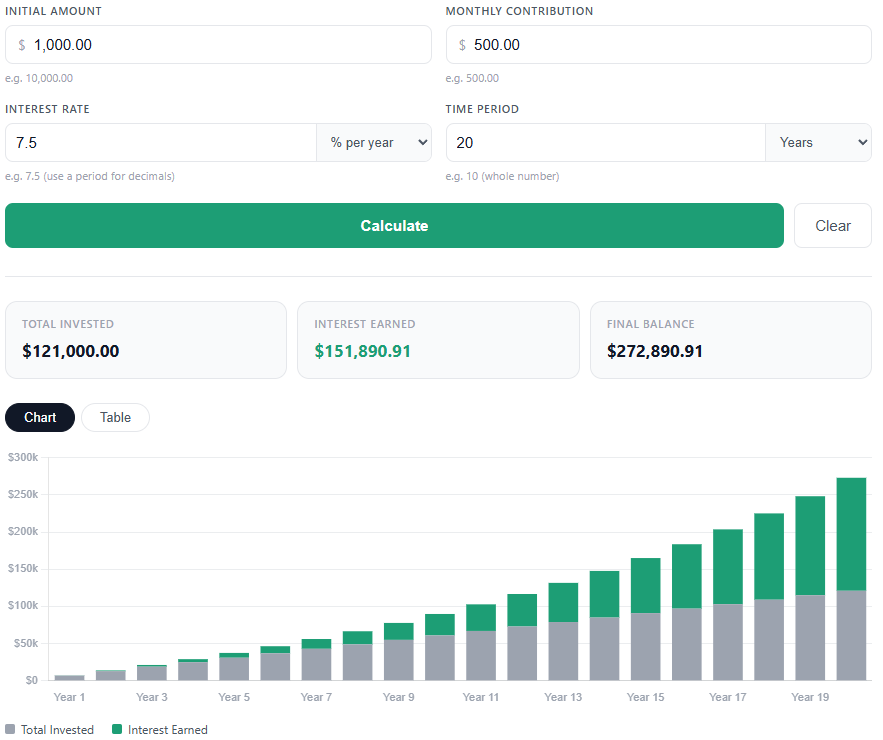
Our Compound Interest Calculator cannot model the Medallion Fund’s 66% annual returns. But it can model what 30 years of consistent, patient compounding actually produces — which is, in its own way, the mathematical principle that Simons spent his career demonstrating.
Frequently Asked Questions
Who was Jim Simons? James Harris Simons (April 25, 1938 – May 10, 2024) was an American mathematician, hedge fund manager, and philanthropist. He founded Renaissance Technologies in 1978 (originally as Monemetrics) and established the Medallion Fund in 1988. He is widely described as the most successful hedge fund manager of all time based on the documented long-term returns of the Medallion Fund. At the time of his death, his net worth was estimated at approximately $31.4 billion by Forbes, making him the 55th-richest person in the world.
What were the Medallion Fund’s actual returns? According to research documented in Gregory Zuckerman’s 2019 book The Man Who Solved the Market and verified by Wikipedia, the Medallion Fund averaged 66.1% per year before fees and 39.1% per year after fees from 1988 to 2018. The fund earned over $100 billion in trading profits since its inception. In 2008, it gained 80% while most funds were losing 20% or more. These figures are from public sources that cited the book; the fund’s own records were never independently audited or disclosed to the public.
How did Jim Simons make his money? Through quantitative, algorithmic trading — using mathematical models to identify statistical patterns in market data and trading based on those patterns without human override. The specific methods have never been disclosed. Simons deliberately hired mathematicians, physicists, and code-breakers rather than traditional investors, believing they were better suited to the pattern-recognition approach he was building. After the fund closed to outside investors in 2005, returns accrued only to current and former Renaissance employees.
Can outside investors invest in the Medallion Fund? No. The Medallion Fund stopped accepting new outside investors in 1993 and removed all outside investors in 2005. Since then, only current and former Renaissance Technologies employees and their families have been permitted to invest. The publicly available Renaissance funds — RIEF, RIDA, and the Diversified Global Equity Fund — have produced significantly lower returns than the Medallion Fund, and in some years produced losses while Medallion gained dramatically.
What mathematical work is Jim Simons known for? Simons developed the Chern-Simons form — a theory in differential geometry and topology developed with Shiing-Shen Chern, described in a 1974 paper. The theory has been applied in theoretical physics, contributing to the mathematical framework of string theory and quantum field theory. He was awarded the Oswald Veblen Prize in Geometry by the American Mathematical Society in 1976. He was elected to the U.S. National Academy of Sciences in 2014.
How much did Jim Simons donate to charity? Simons gave over $4 billion to philanthropic causes during his lifetime, according to Wikipedia. Among the most significant gifts: $500 million to Stony Brook University in 2023 (the second-largest donation ever to a public university in the United States), $60 million to the Simons Institute for Theory of Computing at UC Berkeley in 2012, and decades of funding for Math for America, which he founded in 2004. The Simons Foundation, co-founded with his wife Marilyn in 1994, supports research in mathematics, fundamental sciences, and autism.
When and how did Jim Simons die? Jim Simons died peacefully in New York City on May 10, 2024, at age 86. The Simons Foundation, which he co-founded, announced his death. The foundation stated he had been active in its work until the end of his life. No cause of death was cited in the announcement.
Sources and Further Reading
- Wikipedia — Jim Simons (primary biographical source, including all numerical data on Medallion Fund returns): https://en.wikipedia.org/wiki/Jim_Simons
- InfoMoney / Bloomberg — Jim Simons, matemático “Rei do Quant” e criador do fundo Medallion, morre aos 86 anos (May 10, 2024): https://www.infomoney.com.br/onde-investir/jim-simons-matematico-rei-do-quant-e-criador-do-fundo-medallion-morre-aos-86-anos/
- Simons Foundation — Simons Foundation Co-Founder, Mathematician and Investor Jim Simons Dies at 86 (May 10, 2024): https://www.simonsfoundation.org/2024/05/10/simons-foundation-co-founder-mathematician-and-investor-jim-simons-dies-at-86
- Forbes — Jim Simons profile: https://www.forbes.com/profile/jim-simons/
- Gregory Zuckerman — The Man Who Solved the Market: How Jim Simons Launched the Quant Revolution (2019, Portfolio/Penguin): [Buy on Amazon]
- Wall Street Journal — Gregory Zuckerman, “The Making of the World’s Greatest Investor” (November 2, 2019): https://www.wsj.com/articles/the-making-of-the-worlds-greatest-investor-11572667202
- New York Times — “Stony Brook University to Receive $500 Million, an Uncommonly Large Gift” (June 1, 2023): https://www.nytimes.com/2023/06/01/nyregion/stony-brook-university-gift.html
- Bloomberg — “Simons at Renaissance Cracks Code, Doubling Assets” (October 27, 2008): source cited in Wikipedia references
- Jim Simons — TED Talk: “A Rare Interview with the Mathematician Who Cracked Wall Street” (March 2015): https://www.ted.com/talks/jim_simons_the_mathematician_who_cracked_wall_street
- Investing Time Daily — Michael Burry’s Portfolio: What Is He Betting Against in 2026?: https://investingtimedaily.com/michael-burry-portfolio-2026/
- Investing Time Daily — Jesse Livermore: The Man Who Made $100 Million in the 1929 Crash: https://investingtimedaily.com/jesse-livermore/
- Investing Time Daily — George Soros: The $1 Billion Trade That Broke the Bank of England: https://investingtimedaily.com/george-soros-bank-of-england/
- Investing Time Daily — Compound Interest Calculator: https://investingtimedaily.com/calculators/compound-interest-calculator-free/