
In October 1994, a financial planner named William Bengen published a paper in the Journal of Financial Planning that introduced a single number — 4% — which has since become the most widely cited figure in all of retirement planning.
The idea is simple enough to state: if you withdraw 4% of your retirement portfolio in the first year, then adjust that dollar amount upward for inflation every year after, you will very likely not run out of money over a 30-year retirement. It doesn’t matter much whether markets go up or down. It doesn’t depend on extraordinary returns. Based on over six decades of historical U.S. market data, 4% just works.
Or does it?
In 2025, Bengen himself revised his number upward — to 4.7% — in a new book arguing the original analysis was too conservative. That same year, Morningstar published research suggesting the safe rate for new retirees in 2026 should be lower, not higher — around 3.7% to 3.9%. Two credible, data-backed analyses using similar historical evidence reached conclusions that differ by a full percentage point.
This article explains where the 4% rule came from, what it actually says, why experts now disagree about whether it’s too conservative or not conservative enough, and what it means for anyone planning a retirement in 2026.
Where the 4% rule came from
William Bengen was a financial planner in California with a background in aerospace engineering before he turned to finance. He was, in many ways, an unusual person to upend retirement planning — not an academic, not a Wall Street economist, but someone who sat across from actual clients and had to answer the most important question in personal finance: how much can you spend?
He set about answering it systematically. He took U.S. stock and bond market data going back to 1926 and tested every possible 30-year retirement period within that dataset. For each period, he asked: what is the highest annual withdrawal rate — expressed as a percentage of the starting portfolio — that would not have depleted the portfolio before 30 years were up?
He assumed a portfolio split 50/50 between U.S. stocks and intermediate-term U.S. Treasury bonds, rebalanced annually. He assumed withdrawals were adjusted upward for inflation each year, so the retiree maintained the same purchasing power rather than the same dollar amount.
The worst historical starting year in the dataset was 1966. A retiree who retired in 1966 faced the twin disasters of a stock market that went essentially nowhere for the next 16 years and inflation that averaged nearly 7% per year for a decade. That 1966 retiree barely survived on 4.15% withdrawals — with very little left in the portfolio at the end of 30 years.
Bengen rounded 4.15% down to 4% and called it the SAFEMAX: the maximum “safe” historical withdrawal rate. The name didn’t stick. The number did.
In 1998, three professors at Trinity University in San Antonio — Philip Cooley, Carl Hubbard, and Daniel Walz — published what became known as the Trinity Study, extending Bengen’s analysis across different portfolio compositions and different retirement lengths. Their headline finding confirmed Bengen’s: a 4% initial withdrawal rate with annual inflation adjustments succeeded approximately 95% of the time over 30 years for stock-heavy portfolios. The Trinity Study made the 4% rule mainstream.
How the math actually works
The 4% rule is frequently misunderstood in one specific way: it is not about withdrawing 4% of your portfolio every year. It is about withdrawing 4% of your portfolio in the first year, and then adjusting that dollar amount — not that percentage — for inflation in every subsequent year.
Here is what this looks like in practice:
You retire with $1,000,000. In Year 1, you withdraw $40,000 — 4% of the starting balance.
In Year 2, inflation has run at 3%. You withdraw $41,200 — the same $40,000 adjusted upward by 3%. You do not recalculate 4% of whatever your portfolio is now worth.
In Year 3, inflation runs another 3%. You withdraw $42,436.
Your portfolio may have grown significantly, or it may have fallen. Your withdrawal amount doesn’t change based on portfolio performance — only based on inflation. This is the mechanical discipline that makes the rule work: you spend what you need to maintain your lifestyle, not a volatile percentage of a fluctuating balance.
The corollary to the 4% rule is the 25x rule: the amount you need to retire is 25 times your annual spending, because 25 × 4% = 100%. If you need $40,000 per year to live, you need $1,000,000. If you need $80,000 per year, you need $2,000,000. If you need $120,000, you need $3,000,000.
That 25x figure has become the standard “FIRE number” in the Financial Independence, Retire Early community — the target portfolio size that signals you’ve accumulated enough to sustain yourself indefinitely.
The three risks that can break the rule
The 4% rule is not a guarantee. It is a historical finding about what worked in the past under specific conditions. Three risks can cause it to fail.
Sequence of returns risk is the most dangerous and the least intuitive. It means that the order in which your investment returns arrive matters enormously — not just the average return over your retirement.
Two retirees can experience the exact same average annual return over 30 years and have completely different outcomes if the bad years and good years arrive in a different sequence. A retiree who experiences large losses in the first five years of retirement — before the portfolio has had time to recover — draws down capital at the worst possible moment. Each year they sell assets at depressed prices to fund spending, leaving fewer shares to participate in the eventual recovery. A retiree who experiences the same losses in years 25 through 30 has had two decades of compounding to absorb them.
The 1966 retiree who barely survived on the 4% rule was not unlucky because of average returns — the 30-year average return from 1966 was not terrible. They were unlucky because of sequence: the bad years hit first, in the 1970s, when the portfolio was at its largest and the damage was most consequential.
Inflation risk is the second major threat. The 4% rule is designed to protect purchasing power, not just nominal dollars — you increase your withdrawal each year by the inflation rate. But if inflation is substantially higher than historical averages for an extended period, even inflation-adjusted withdrawals can stress the portfolio beyond what the historical analysis anticipated.
The 1970s showed what this looks like: inflation averaged nearly 7% annually for much of the decade. A retiree who started in 1966 experienced both an equity market going nowhere and their withdrawal amounts compounding at 7% per year. The 4% rule survived that historical stress test — barely — but it does not mean every future high-inflation period will end as well.
Longevity risk — living longer than 30 years — is the structural limitation of the original analysis. Bengen designed the rule for a 30-year retirement. If you retire at 55 instead of 65, or if medical advances mean your retirement lasts 40 or 50 years, the math changes substantially.
The Poor Swiss analysis of the Trinity Study data, updated through 2026, found that over a 50-year retirement horizon, the 4% withdrawal rate has only a 90% historical success rate rather than 95%. For 40 to 50-year retirements, researchers generally recommend a 3.5% withdrawal rate as meaningfully safer.
Does the 4% rule still work in 2026?
This is where the current debate sits — and where the honest answer is more nuanced than either “yes, it’s fine” or “no, it’s broken.”
The original Trinity Study conclusions still hold when tested through 2026 data. The rule has a high historical success rate over 30-year periods. The data has not changed the fundamental finding.
What has changed is the forward-looking picture.
Morningstar’s most recent research — published in 2025 for the 2026 planning environment — suggests that a new retiree today should use a starting withdrawal rate of approximately 3.7% to 3.9% to achieve a 90% probability of success over a 30-year retirement. This is lower than the historical 4%, and the reason is straightforward: Morningstar’s analysis uses forward-looking capital market assumptions — projected future returns based on current valuations, yields, and economic conditions — rather than backward-looking historical averages. If future stock and bond returns are somewhat lower than the historical averages embedded in the original study, a lower withdrawal rate is needed to achieve the same probability of success.
On the other side of this debate is Bengen himself. In his 2025 book A Richer Retirement: Supercharging the 4% Rule to Spend More and Enjoy More, he argues the original analysis was actually too conservative. By expanding the portfolio allocation to include small-cap U.S. stocks and international equities — rather than the simple large-cap U.S. stock and bond allocation of the original study — he raises the historically sustainable withdrawal rate to 4.7%.
Both are defensible. They answer different questions. Bengen looks backward and asks: given a more diversified portfolio, what was the highest rate that never failed historically? Morningstar looks forward and asks: given current starting conditions, what rate gives a 90% probability of success over the next 30 years?
For practical planning in 2026, the honest answer is: somewhere between 3.7% and 4.7%, with the right number for any individual depending on their portfolio composition, retirement length, spending flexibility, and how much certainty they need.
One context worth noting: the 4% rule struggled most in the period from 2010 to 2021, when interest rates were near zero and bond returns were negligible. The current environment — with interest rates elevated across developed economies — is actually more favorable for the rule than recent history was. Higher rates mean bonds generate real income again, which supports the portfolio through drawdowns.
The FIRE community and longer retirements
The Financial Independence, Retire Early movement has adopted the 4% rule as its foundational framework, using the 25x rule to define the retirement target. But the FIRE community’s use case is precisely the one the original research was not designed for.
Bengen’s analysis covered 30-year retirements. Someone who retires at 35 may need their portfolio to last 60 years. At that horizon, a 4% withdrawal rate has a substantially lower historical success rate than over 30 years, and the sequence-of-returns risk is more consequential because there are more years in which a bad early sequence can derail the plan.
Researchers studying the FIRE use case — particularly at ChooseFI — have generally concluded that a 3.5% withdrawal rate provides meaningfully more safety for retirements lasting 40 to 50 years, and that incorporating Social Security or other income sources later in retirement (which reduces portfolio withdrawals in later years) can significantly improve the sustainability of an early-retirement plan built around a higher initial rate.
How to think about your own number
The 4% rule is a starting point, not an ending point. Several adjustments make it more relevant to individual circumstances.
Consider your spending flexibility. The rule’s historical success depends partly on the mechanical discipline of withdrawing the same inflation-adjusted amount regardless of market conditions. In practice, most people spend less when markets are down and more when they’re up. Portfolios with flexible spending — sometimes called “guardrails” approaches — tend to support higher initial withdrawal rates than rigid fixed-spending models.
Account for other income sources. If you have Social Security income, a pension, rental income, or other sources that will cover part of your expenses, the amount your portfolio needs to support is lower than your total spending. The 4% rule applies to the portion of spending funded by the portfolio, not to total spending.
Adjust for your time horizon. If you expect a 30-year retirement, the 4% rule’s historical track record is directly applicable. If you expect 40 or more years, consider a more conservative starting rate of 3.5% or model your plan with a financial planner who can run Monte Carlo simulations specific to your situation.
Don’t ignore taxes. The original research assumed a tax-free account. If withdrawals trigger income tax, the gross withdrawal needed to fund a given level of spending is higher than the net amount. This affects the effective withdrawal rate relative to the pre-tax portfolio value.
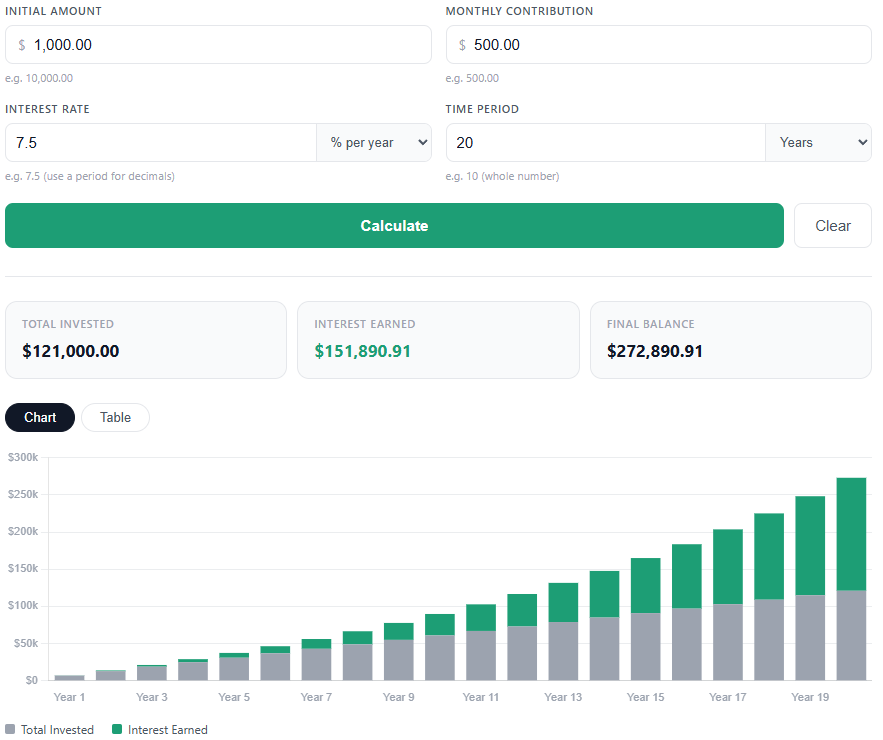
Our Compound Interest Calculator can help you model how your portfolio grows during the accumulation phase — seeing how monthly contributions compound over 10, 20, or 30 years toward the 25x number that defines retirement readiness. The math of getting there is ultimately what the 4% rule is designed to protect.
Frequently Asked Questions
What is the 4% rule? The 4% rule is a retirement planning guideline established by financial planner William Bengen in 1994. It states that a retiree can withdraw 4% of their portfolio in the first year of retirement, then adjust that dollar amount upward for inflation each year, and have a very high probability — approximately 95% over a 30-year period based on historical U.S. market data — of not depleting the portfolio.
Where did the 4% rule come from? Bengen published “Determining Withdrawal Rates Using Historical Data” in the Journal of Financial Planning in October 1994, testing every rolling 30-year period of U.S. market returns from 1926 onward. He found that 4.15% — rounded to 4% — was the highest withdrawal rate that never depleted a portfolio in any historical period. The 1998 Trinity Study by Cooley, Hubbard, and Walz at Trinity University further confirmed and popularized the finding.
Does the 4% rule still work in 2026? The original historical research still holds when tested through 2026 data. However, forward-looking analyses differ: Morningstar’s 2026 research suggests a safer starting rate of 3.7% to 3.9% based on projected future returns, while Bengen himself has revised his number upward to 4.7% using a more diversified portfolio including small-cap and international stocks. For planning purposes, the range of 3.7% to 4.7% reflects current informed debate, with the appropriate number depending on portfolio composition, retirement length, and spending flexibility.
What is the 25x rule? The 25x rule states that you need 25 times your annual spending to retire safely under the 4% framework, because 25 × 4% = 100% of the required portfolio. If you spend $50,000 per year, you need $1,250,000. If you spend $80,000 per year, you need $2,000,000. This figure has become the standard “FIRE number” in the Financial Independence, Retire Early community.
What is sequence of returns risk? Sequence of returns risk is the danger that poor market performance early in retirement — when the portfolio is at its largest — permanently impairs your ability to sustain withdrawals, even if long-run average returns are adequate. Two retirees with the same average return over 30 years can have dramatically different outcomes if the bad years arrive first versus last. It is the most significant practical risk to the 4% rule and is the reason a retiree who started in 1966 — facing a flat equity market and high inflation in their early retirement years — barely survived on 4% withdrawals.
Is the 4% rule safe for FIRE (early retirement)? The original 4% rule was designed for a 30-year retirement. For early retirees who may need 40 to 50 years of portfolio support, the historical success rate drops from approximately 95% to around 90% at 50 years. Most researchers studying FIRE use cases recommend a 3.5% withdrawal rate for retirements expected to last 40 or more years, combined with incorporating later Social Security income to reduce portfolio withdrawals in the retirement’s later phase.
What is the difference between 4% and 4.7%? Bengen’s 2025 book revised his SAFEMAX upward to 4.7% by expanding the portfolio allocation to include small-cap U.S. stocks and international equities, which historically improved returns compared to the simple large-cap U.S. stock and bond portfolio of the original study. The 0.7 percentage point difference has meaningful practical consequences: a $1,000,000 portfolio supports $40,000 in annual spending at 4% versus $47,000 at 4.7% — a difference of $7,000 per year, or nearly $210,000 over 30 years.
Sources and Further Reading
- William Bengen — “Determining Withdrawal Rates Using Historical Data,” Journal of Financial Planning, October 1994 (original paper establishing the 4% rule): https://www.financialplanningassociation.org
- Cooley, Hubbard & Walz — “Retirement Savings: Choosing a Withdrawal Rate That Is Sustainable,” AAII Journal, February 1998 (the Trinity Study): https://www.aaii.com
- Wikipedia — 4% Rule: https://en.wikipedia.org/wiki/4%25_rule
- Wikipedia — William Bengen: https://en.wikipedia.org/wiki/William_Bengen
- Morningstar — “What’s a Safe Retirement Withdrawal Rate for 2026?” (3.9% safe rate analysis): https://www.morningstar.com/retirement/whats-safe-retirement-withdrawal-rate-2026
- The Poor Swiss — Updated Trinity Study for 2026 (success rates by time horizon): https://thepoorswiss.com/updated-trinity-study/
- CompoundLadder — 4% Rule 2026: Bengen’s 4.7% Safe Withdrawal Update (May 2026): https://www.compoundladder.com/guides/4-percent-rule
- RetireWellCalc — The 4% Rule: Safe Retirement Withdrawals Explained (March 2026): https://retirewellcalc.com/guides/4-percent-rule
- Retiree Advisor Match — Safe Withdrawal Rates: What the 4% Rule Actually Means in 2026: https://financial-advisors-for-retirees.com/safe-withdrawal-rate/
- Edward F. McQuarrie — “How the 4% Rule Would Have Failed in the 1960s,” SSRN, February 2025: https://ssrn.com
- William Bengen — A Richer Retirement: Supercharging the 4% Rule to Spend More and Enjoy More (2025): https://amzn.to/4fYpw67
- Investing Time Daily — Compound Interest Calculator: https://investingtimedaily.com/calculators/compound-interest-calculator-free/
- Investing Time Daily — What is the S&P 500? A Complete Guide: https://investingtimedaily.com/what-is-the-sp-500/
- Investing Time Daily — How to Start Investing: Simple Guide for Complete Beginners: https://investingtimedaily.com/how-to-start-investing-beginners-guide/
Disclosure: This post contains affiliate links. If you click and buy, I may earn a small commission at no extra cost to you.