
Insights from Professor Ray Madoff & Her Book The Second Estate
Affiliate Disclosure:
This article contains affiliate links. If you purchase through them, we may earn a commission at no additional cost to you.
Introduction
In a recent in-depth discussion, Boston College Law School professor Ray Madoff breaks down one of the most confusing—and controversial—topics in American finance: why the richest Americans often pay little to no federal tax, despite controlling unprecedented levels of wealth.
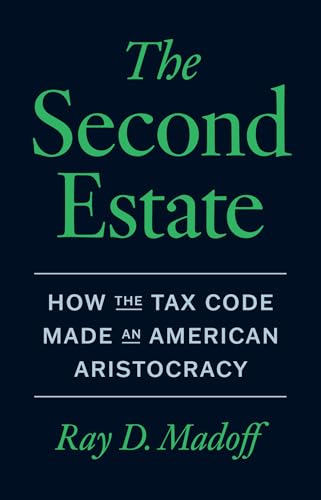
Her analysis is grounded, data-driven, and historically contextual. And it pairs perfectly with her acclaimed book:
👉 “The Second Estate: How the Tax Code Made an American Aristocracy”
https://amzn.to/48qf0Q4
The U.S. Tax System vs. the Real Distribution of Wealth
According to Madoff, in 2024 the U.S. government collected roughly $5 trillion in total revenue but spent $6.8 trillion, creating a $1.8 trillion deficit.
Meanwhile, the wealthiest Americans collectively own $46 trillion—a staggering contrast.
The core issue:
The U.S. tax system looks progressive on paper, but in practice the wealthiest Americans avoid taxation through structural loopholes, not illegal behavior.
The “Second Estate”: A Modern American Aristocracy
Madoff uses a historical analogy from pre-revolutionary France:
- The Second Estate = the aristocracy
- They were exempt from most taxes
- They controlled wealth, influence, and generational power
She argues that modern U.S. tax rules have unintentionally replicated this model:
“We’ve created our very own Second Estate… the wealthiest Americans who are exempt from paying federal taxes.”
Her book explores this in depth
How the Ultra-Wealthy Avoid Taxable Income
Madoff explains that the wealthiest Americans do not earn their wealth through wages or ordinary income. Instead, they accumulate wealth through assets, whose value:
- grows dramatically
- but isn’t taxed unless sold
This is the key distinction between income and wealth.
Why they rarely sell assets
Selling stock triggers income taxes.
So instead, ultra-wealthy individuals:
→ Borrow against their assets
A method known as “buy, borrow, die” allows them to:
- live on loans (tax-free)
- keep ownership and control
- avoid generating taxable income
This technique is widespread among billionaires. And she confirms:
“People with wealth can borrow against those assets… and get tax-free wealth that is never subject to tax.”
The Estate Tax: Once a Backstop, Now a Hollow Shell
The U.S. estate tax was designed to ensure that untaxed gains would eventually be taxed when wealth is transferred across generations.
But there’s a problem:
There has been no significant amendment to the estate tax since 1990.
During that time:
- wealth has soared
- loopholes have exploded
- revenue from the estate tax has collapsed to less than 0.5% of federal revenue
Madoff highlights that:
“The estate tax has become absolutely riddled with loopholes.”
This means the wealthy can transfer billions tax-free through:
- GRATs
- valuation discounts
- dynasty trusts
- donor-advised funds (DAFs)
Inherited Wealth: America’s Most Untaxed Income
One of the most striking explanations in the interview:
Gifts, inheritances, and insurance payouts are 100% excluded from income tax.
So someone who inherits $100 million owes zero income tax.
“The income tax system totally excludes all money received by gifts, inheritances, or insurance distributions.”
This is how wealth becomes dynastic.
Why High-Income Earners Are Not the Same as High-Wealth Owners
Many Americans confuse:
- high earners (e.g., doctors, lawyers)
- with high-wealth individuals (e.g., billionaires who borrow rather than sell assets)
High-income earners do pay significant taxes — roughly 40% of all income taxes.
But high-wealth individuals?
“High wealth owners are hiding behind high income earners.”
This misunderstanding shapes public opinion — and policy avoidance.
Payroll Taxes: The Hidden Burden on Working Americans
One of the most overlooked insights:
Payroll taxes make up 35% of all U.S. government revenue.
They fund:
- Medicare
- Social Security
And they are highly regressive:
- 15.3% applies starting at dollar one
- low-income earners pay the largest share of their income in payroll tax
- unlike income tax, payroll tax cannot be offset by charitable giving
Meanwhile, the wealthy often have no payroll tax liability at all.
Charitable Giving: Two Systems, Two Americas
Madoff highlights a little-known truth:
90% of Americans receive zero tax benefit from charity.
That’s because they don’t itemize deductions.
But for the wealthy, charitable giving is a powerful tax tool:
- they avoid capital gains
- they avoid estate tax
- they get deductions far beyond what working families receive
Some charitable structures:
- donor-advised funds
- private foundations
…allow the wealthy to receive tax benefits today without guaranteeing money will ever reach the public.
The 1982 Rule That Changed the Stock Market Forever
Before 1982:
- companies couldn’t legally buy back their own stock
- the stock market moved sideways for ~70 years
- returns came mostly from dividends (taxable)
After 1982:
Stock buybacks became legal → the market soared.
Madoff points out:
- growth replaced dividends
- growth is untaxed until realization
- this system massively benefits asset owners
And it helps explain why billionaire tax liabilities stay low.
Potential Solutions (Non-Political, Structural Suggestions Only)
Ray Madoff does not advocate for a wealth tax.
Instead, she highlights two realistic reforms:
1. Tax unrealized gains at death or transfer
Already used in Canada.
2. Repeal the estate tax—but also repeal the inheritance exclusion
Not to increase tax burden, but to:
- simplify the system
- stop hidden loopholes
- reduce distortion
- treat working Americans and wealthy Americans under similar rules
Conclusion
Ray Madoff’s explanation shows that the debate around “why the rich don’t pay taxes” is not about personal morality or politics — but structural design. Over decades, laws, loopholes, and financial innovations have created a system where:
- working Americans pay predictable, unavoidable taxes
- wealthy Americans structure their lives to avoid taxable income entirely
- the estate tax no longer serves its intended purpose
- charitable rules favor wealth preservation over public benefit
Understanding these mechanics is essential for anyone studying personal finance, tax policy, or American economic history.