Introduction: Money Advice That Isn’t About Money
When Morgan Housel talks about money, he rarely talks about:
❌ stock picks
❌ market timing
❌ forecasts
❌ shortcuts
Instead, he talks about behaviors, emotions, stories, incentives, and psychology — the real forces that drive financial outcomes.
In his conversation with Jay Papasan on The ONE Thing Podcast, Housel reveals some of his most important insights on:
- spending
- fear
- regret
- uncertainty
- decision-making
- identity
- the role of mistakes
- how stories shape financial outcomes
Let’s break down the most important lessons.
1. “Everything Has a Price — The Price Is Not Always Dollars”
One of the core ideas from the interview is that decisions rarely come down to money alone.
Housel explains that every choice has a cost, but the cost is often hidden — a cost in:
- reputation
- time
- regret
- flexibility
- identity
This mirrors a key idea from The Psychology of Money:
“Everything has a price, but not all prices appear on the tag.”
— The Psychology of Money, Morgan Housel (2020)
In the podcast, he emphasizes that choices have non-monetary consequences — and these consequences shape how people behave with money.
2. The Most Important Skill in Money Isn’t Intelligence — It’s Behavior
In the episode, Morgan highlights that emotions drive decisions more than analysis.
This is consistent with a central theme in his writing:
“Financial success is not a hard science. It’s a soft skill, where how you behave is more important than what you know.”
— The Psychology of Money (2020)
Throughout the conversation, Housel explains how:
- people make decisions under uncertainty
- emotions bias outcomes
- fear often overrides logic
- incentives distort choices
This matches his interview statements about people reacting to stories rather than facts.
The conversation reinforces a truth you see throughout his books:
Better behavior > better information.
3. Why People Struggle With Long-Term Thinking
Housel tells Jay that humans evolved for immediate decision-making — not decades-long planning.
This aligns with his essays about recency bias and evolutionary incentives.
He points out that:
- people are wired for short-term rewards
- discomfort pushes us toward fast answers
- we often seek clarity even when clarity doesn’t exist
These explanations appear throughout the conversation when discussing time horizons and expectations.
This is why long-term investing is emotionally hard, even if mathematically simple.
4. Wealth Is What You Don’t See
One of Housel’s most popular concepts is that wealth is invisible:
- It is the money not spent
- The purchases not made
- The lifestyle not upgraded
- The optionality kept intact
He reinforces this by explaining why people misjudge others’ financial success — because they only see spending, not saving.
In the interview, he references how people often try to signal success through consumption, which distorts our perception of financial reality.
From his book:
“Past a certain level of income, what you don’t see is more important than what you do see.”
This is one of the most important parts of the entire podcast.
5. The Most Dangerous Financial Mistakes Come From Stories — Not Math
Morgan points out that people behave based on stories they believe:
- narratives from childhood
- traumas
- cultural expectations
- past successes or failures
He explains that stories overpower data because they feel more meaningful and more personal.
In the interview, he describes the way narratives shape behavior:
This matches his writings:
“Stories are more powerful than statistics because they make us feel something.”
Understanding this is essential to understanding money — because almost everyone’s finances are driven by their life story.
6. Why People Misunderstand Risk
One of the strongest parts of the interview is Housel’s explanation of risk as a personal experience, not a mathematical model.
He explains that:
- People who lived through inflation fear inflation
- People who lived through layoffs fear unemployment
- People who lived through recessions fear volatility
Risk is autobiographical.
This connects to the interview passages about how two rational people can make opposite decisions because they lived different lives.
And it ties directly to Same As Ever:
“Different people can look at the same facts and make different decisions because they experience the world differently.”
7. Expectations Are the Root of Almost Every Financial Problem
In the interview, Housel shares one of his most important observations:
Expectations rise faster than reality can satisfy them.
He explains that when expectations increase:
- satisfaction decreases
- ambition becomes stress
- comparison becomes misery
This is one of the defining lessons of the conversation.
And from The Psychology of Money:
“Expectations shift faster than circumstances. That is the biggest reason people feel unhappy even when they are doing well.”
If you manage your expectations, you manage your financial life.
8. The Real Goal of Money Is Control Over Your Time
This is one of Housel’s signature ideas.
In the interview, he expands on:
- autonomy
- flexibility
- reducing regret
- optionality
- freedom from forced choices
From The Psychology of Money:
“The highest form of wealth is the ability to do what you want, when you want, with who you want, for as long as you want.”
This appears throughout the interview when discussing time leverage and decision quality.
Money is not about consumption.
It’s about control.
Morgan Housel Books (Affiliate)
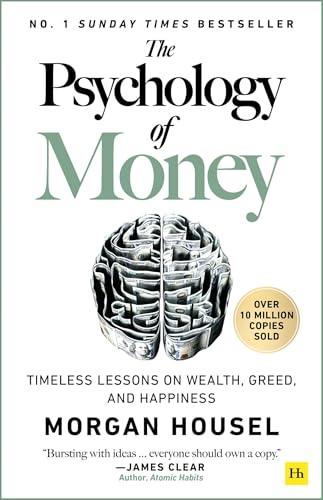
The Psychology of Money
A foundational book on behavior, bias, and financial decision-making.
👉 https://amzn.to/4pskJLZ
Same As Ever
A book about what never changes — incentives, emotions, expectations, risk perception.
👉 https://amzn.to/3XTAvDL

FAQ — Based on Actual Search Queries About Morgan Housel
What is Morgan Housel’s investment advice?
He does NOT give investment recommendations.
He focuses on behavior, history, risk, patience, and simplicity.
What does Morgan Housel invest in?
Publicly shared principles:
- low-cost index funds
- conservative allocation
- long-term horizons
He does not reveal specific stocks.
Is Morgan Housel a millionaire?
He does not disclose wealth figures.
Does Morgan Housel publish his portfolio?
No — he only shares principles, never positions.